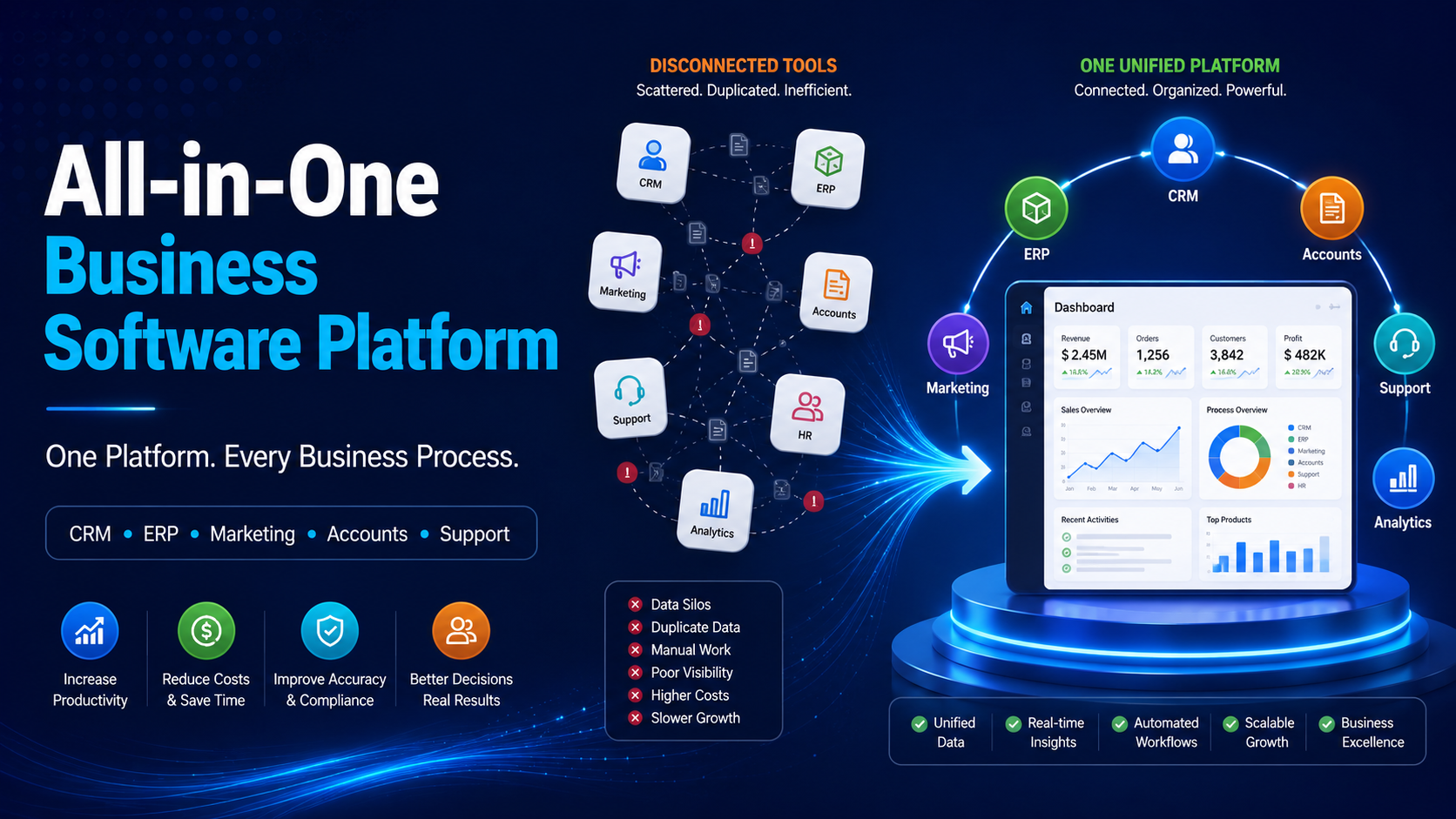
Most small businesses don't set out to use ten different software tools — it happens gradually. A billing app here, a WhatsApp broadcast tool there, a separate CRM, a different email marketing platform, a standalone website builder. Each individual subscription seems reasonable, but the combined cost — in money, time, and data scattered across disconnected systems — is usually far higher than business owners realize. This is exactly the problem an all-in-one business software platform is built to solve.
The Real Cost of Disconnected Tools
Subscription Costs Add Up Silently
Five ₹500-a-month tools quietly cost the same as one comprehensive ₹2,500 platform — except the disconnected version doesn't share data between any of them.
Data Lives in Silos
Customer information sits in the CRM, purchase history sits in the billing tool, campaign performance sits in the marketing tool — and none of them talk to each other, so no one gets a complete picture of a customer without manually cross-referencing multiple systems.
Training Time Multiplies
Every new tool means another login, another interface, and another round of training for staff — time that adds up fast for a small team that doesn't have a dedicated IT department.
Nothing Actually Automates End-to-End
A lead captured on your website should be able to flow into your CRM, trigger a WhatsApp follow-up, and eventually generate a bill — automatically. Disconnected tools break this chain at every handoff, requiring manual work to bridge the gaps.
What "All-in-One" Should Actually Mean
Simply bundling unrelated tools under one login isn't the same as true integration. A real all-in-one platform means:
- Shared customer data across CRM, billing, and marketing — one customer record, not five
- Automated handoffs between modules, like a website lead automatically entering your CRM and marketing sequence
- One dashboard for reporting, instead of compiling numbers from five different tools manually
- Consistent support and updates, from a single provider instead of juggling five separate vendors
When a Single Platform Makes the Most Sense
A unified platform delivers the most value for businesses that need several core functions working together — sales, marketing, billing, and customer communication — rather than one narrow, highly specialized need. For most small and mid-sized businesses managing customers, campaigns, and daily operations, this covers the majority of what they actually do day to day.
What to Check Before Consolidating Onto One Platform
- Does it cover the core functions your business actually uses, not just impressive-sounding extras?
- Is data genuinely shared across modules, or just accessible from the same login?
- What does migrating your existing data actually involve?
- Is pricing predictable as your business and usage grows?
DataBridgeCRM's All-in-One Approach
DataBridgeCRM combines CRM, ERP, billing, WhatsApp/email/SMS marketing, AI tools, website builder, and business workspace tools into a single platform, starting at ₹50/day. Rather than five different logins and five different subscriptions, businesses across 25+ industries run their operations from one connected system, backed by 99.9% uptime and 24/7 support.
Consolidate Onto One System
If your business is currently running on a patchwork of disconnected tools, book a free demo of DataBridgeCRM and see what moving to one connected platform could save in both cost and time.

