
Most Indian
business owners have experienced some version of this scenario: your sales
team's CRM, your accounts team's billing software, your warehouse's inventory
system, and your marketing team's email platform are all completely separate.
Data has to be
manually transferred between them. It's always slightly out of sync. Decisions
are based on information that was accurate three days ago.
This is the hidden cost of running your business on five separate tools that were never designed to work together.
The Real Cost of Disconnected Systems
The direct
costs of tool subscriptions are visible. The hidden costs of disconnected
systems are usually larger:
•
Staff time manually transferring data between systems —
often hours per week
•
Errors that occur in manual data transfer — wrong
numbers, missed entries
•
Decisions made on stale data because the sync hasn't
happened yet
•
Customer experience suffering because one department
doesn't have information another created
•
Training time and cost multiplied by the number of
tools your team uses
A business
running five separate tools is also running five support contracts, five
renewal cycles, and five different interfaces that every staff member has to
learn.
What All-in-One Actually Means
"All-in-one"
is overused in software marketing. Here's what it should actually mean for a
growing Indian business:
•
One login for every function — no switching between
apps and re-authenticating
•
One customer record — sales, support, billing, and
marketing all see the same data
•
One inventory — what's available for sale is what's
actually in stock, in real time
•
One finance view — revenue, expenses, and outstanding
payments in one dashboard
•
One communication platform — WhatsApp, SMS, and email
campaigns from the same place
When a system
is genuinely integrated, the whole business becomes more than the sum of its
parts.
The Indian SME Case for Integration
Small and
medium Indian businesses face a specific challenge with disconnected tools:
limited staff to manage them.
A large
enterprise can have a CRM admin, an ERP specialist, a marketing ops person, and
a finance team. An Indian SME with 15 people can't. One person often handles
customer management, billing, and part of the marketing.
All in one crm erp
software india isn't a luxury for these businesses — it's a
necessity. A single person needs to be able to raise an invoice, update the
CRM, and trigger a WhatsApp message without logging into three different
systems.
Industry-Specific Integration: Where It Gets Powerful
The real power
of an integrated platform emerges when it's tailored to a specific industry:
•
Hotel — booking, housekeeping, restaurant billing, and
guest CRM in one view
•
School — admissions, fees, attendance, exams, and
parent communication connected
•
Hospital — appointments, medical records, billing,
pharmacy, and lab in one system
•
Restaurant — table management, kitchen display,
billing, and customer loyalty linked
Generic
all-in-one platforms that try to serve all industries equally often serve none
of them particularly well. The most effective platforms are those built with
industry-specific workflows at their core.
Making the Decision
The question
isn't whether an integrated platform is better than separate tools — it clearly
is. The question is which integrated platform fits your industry, your scale,
and your team's ability to adopt it.
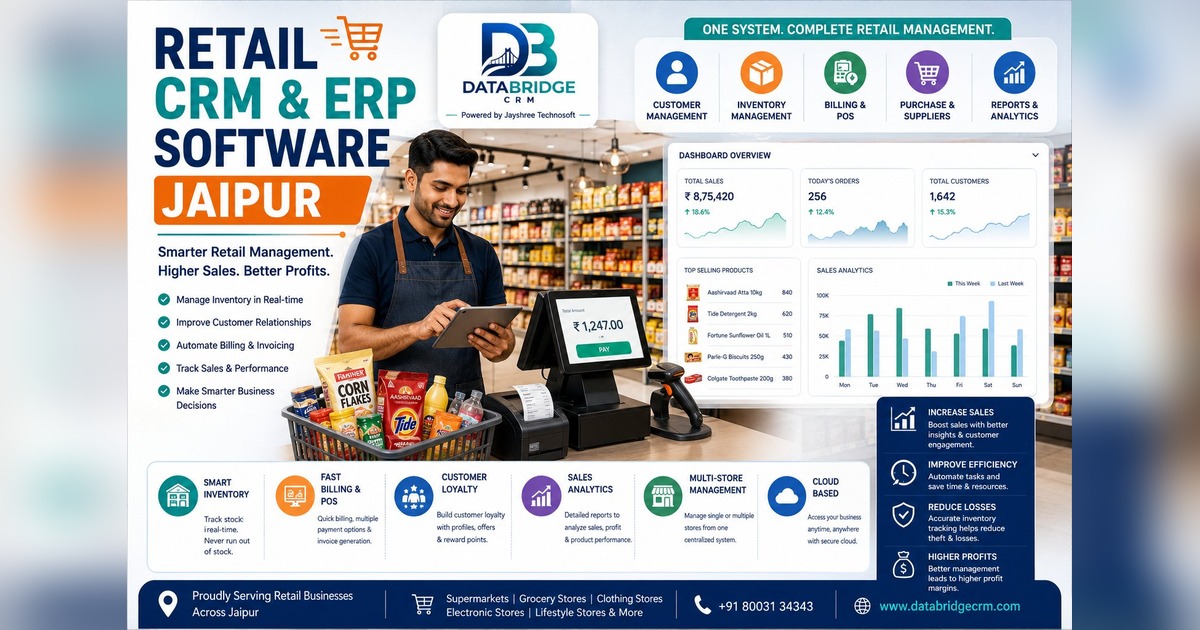
Databridge CRM by Jayshree Technosoft offers industry-specific CRM and ERP integration built for Indian businesses — with local support, GST compliance, WhatsApp integration, and pricing from ₹50/day that makes genuine integration accessible at every stage of growth.
Databridge CRM | Powered by
Jayshree
Technosoft |
databridgecrm.com

