
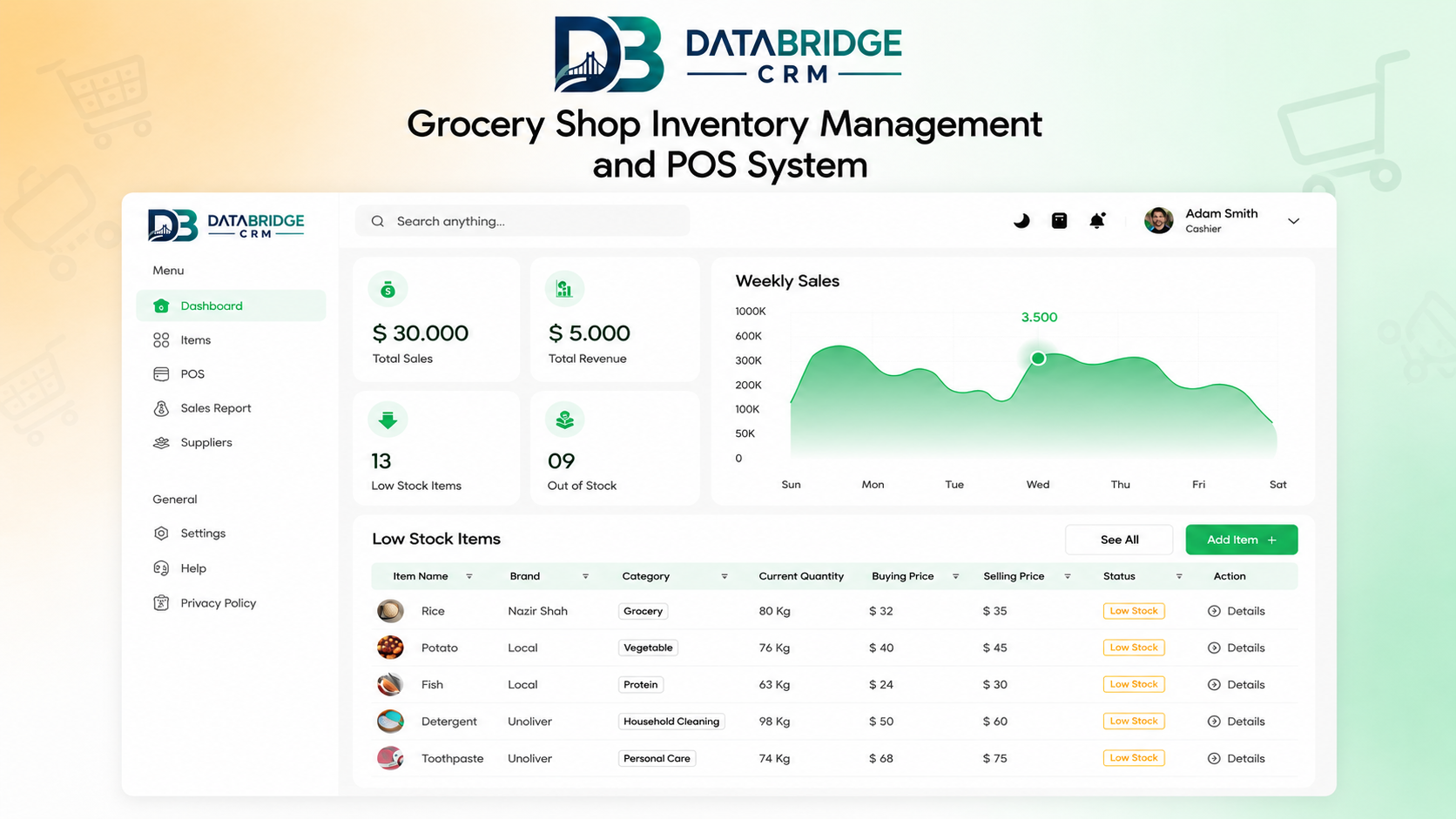
In a supermarket or general store, software has one job above all others: get the customer billed and out. Everything else — inventory, reports, loyalty — matters, but not at the cost of the counter.
This guide covers what billing and inventory software should do for Indian retail, what to test before buying, and where stores lose money without noticing.
The Test That Decides Everything
How many seconds to bill twenty items and take payment?
During peak hours, every extra second builds a queue. Ask to bill twenty of your own products in the demo — including one loose item without a barcode, one with a discount, and one that needs to be removed after scanning.
Count the time. That number, multiplied across hundreds of bills a day, is your queue length, your customer experience, and eventually your reputation.
What Retail Software Actually Needs to Handle
Fast, forgiving billing
Barcode scanning that adds items instantly. Quick search or shortcut keys for loose and unbarcoded items — which in Indian general stores is a large share of the catalogue. Easy removal of a wrongly scanned item. Price override with a recorded reason.
Weight-based and loose items
Grains, pulses, vegetables, sweets. Weighing scale integration where relevant, and clean handling of quantity-by-weight pricing. Generic retail software built for packaged goods handles this poorly, and it's a large part of an Indian store's business.
Multiple units and packs
The same product sold as a piece, a dozen, and a box, at different rates. Stock needs to reduce correctly whichever way it sells. This is where many systems quietly break.
GST billing, correctly
Different tax slabs per item, correct invoice format, and reports your accountant can use directly at filing time. This should be standard, not an add-on module.
Stock that updates itself
Every sale reduces stock automatically. This single feature ends the monthly nightmare of physical counts never matching the register — and quietly reveals leakage.
Purchase and supplier management
Recording incoming stock, supplier-wise purchase history, payment dues, and reorder alerts based on actual sales rather than guesswork.
Payment handling
Cash, card, UPI, and split payments across them. UPI must be immediate and prominent — for a large share of Indian shoppers it's the default, and fumbling it at the counter costs time on every transaction.
The Requirements Generic Systems Miss
Billing must work when the internet drops. Absolutely non-negotiable in Indian retail. Power cuts and connectivity gaps are routine, and a system that stops billing during one stops being trusted permanently. Ask to see it demonstrated.
Staff turnover is high and training time is short. A new counter person should be billing within an hour. If it needs a training programme, it will be used badly.
Credit customers (udhaar). Regular customers who pay later are normal in Indian retail, and most modern retail software handles this poorly or not at all. Balance tracking per customer, partial payments, and statements matter.
Affordable hardware. A computer or tablet you already have, a barcode scanner, a thermal printer. Be sceptical of vendors insisting on expensive proprietary machines.
Where Stores Lose Money Invisibly
Shrinkage nobody can quantify. Without stock linked to sales, the gap between what should be on the shelf and what is remains invisible. Stores implementing proper tracking commonly find this is their largest recoverable cost.
Expiry and slow-moving stock. Money sitting on shelves in products nobody buys, and near-expiry items nobody flagged. Expiry alerts pay for themselves in perishables and packaged goods alike.
Buying on instinct. Reordering based on memory rather than sales data means over-stocking what doesn't sell and running out of what does.
Uncontrolled discounts. Counter-level discounts and staff purchases that nobody records add up substantially across a year.
Customers you never reach again. Most stores know nothing about their regulars. Capturing a phone number at billing allows offers later — and returning customers cost far less than new ones.
What to Test in the Demo
Do these yourself with your own products:
Bill twenty items including one loose item and one discount. Remove an item after scanning. Take a split payment across cash and UPI. Record a credit sale to a regular customer and then a partial repayment. Add incoming stock from a supplier. Check the GST report. Disconnect the internet mid-bill. And run the day-end closing process — how long does it take?
Cost Questions Worth Asking
Is pricing per counter, per store, or per user? What is the total first-year cost including setup, product data entry, and training? Who enters our existing product catalogue and stock — us or you? What happens when we open a second store? And what does support look like on a Sunday evening?
Getting Started Sensibly
The most common failure is trying to enter every product perfectly before going live. Stores spend weeks on data entry, lose momentum, and abandon the project.
Better: start with your fastest-moving products — usually a fraction of your catalogue covering most of your sales — go live, and add the rest gradually as items sell. Billing works from day one, and the catalogue completes itself over a few weeks.
Our Approach
DataBridgeCRM's Supermarket CRM and General Store CRM are built around Indian retail realities — fast billing with barcode and quick-search, loose and weight-based items, multiple units, GST compliance, credit customer tracking, and stock that updates on every sale.
They connect to our wider platform, so billing links to inventory, customer records, and WhatsApp communication — which means the regular customer who shops weekly is someone you can actually reach with an offer.
Running a store and evaluating systems? Book a free demo — bring your own products and bill them yourself. That tells you more than any presentation.

