
Hotel software gets sold on module lists — front desk, housekeeping, POS, channel manager, revenue management. What actually determines whether a system helps is far simpler: whether check-in stays fast when four guests arrive at once and the internet is playing up.
This guide covers what hotel management software should do, what to test before buying, and the requirements specific to Indian hotels that generic systems miss.
The Test That Decides It
How long does a walk-in check-in take?
Ask to do it yourself in the demo — a guest arrives without a booking, needs a room, has ID to record, and wants a bill format for company reimbursement. Count the screens and the time.
Your front desk repeats this hundreds of times a month, often with a queue forming behind. A system that takes four minutes instead of ninety seconds doesn't cost you seconds; it costs you guest experience at the exact moment first impressions form.
What Hotel Software Actually Needs to Handle
Bookings from everywhere, in one place
Direct bookings, phone bookings, walk-ins, travel agents, and OTA platforms. When these live in separate systems, someone reconciles them manually every night — and double-bookings become inevitable.
Channel synchronisation matters more than any other integration for hotels. When a room sells on one platform, availability must update everywhere within moments.
Rate management that reflects reality
Indian hotel pricing is rarely one number. Season rates, weekend rates, corporate rates, agent commissions, group rates, and last-minute adjustments. If changing rates for a date range takes twenty clicks, it won't happen often enough.
Front desk operations
Check-in with ID capture, room allocation, guest history, early check-in and late check-out handling, room changes mid-stay, and extending a stay. These sound minor and occur constantly.
Housekeeping coordination
Room status visible to front desk in real time — dirty, cleaning, ready, maintenance. The classic failure is a guest checking into a room that hasn't been cleaned because the status was updated on paper.
Billing that handles Indian requirements
GST-compliant invoicing with correct slabs, split billing between guest and company, advance payments and deposits, restaurant and service charges posted to the room, and settlement across cash, card, and UPI. Corporate guests frequently need specific invoice formats — get this tested.
Reporting owners actually use
Occupancy, average room rate, revenue per available room, source of bookings, and outstanding receivables from agents. Available on a phone, because owners check these between other things.
The Requirements Generic Systems Miss
It must work when the internet drops. Non-negotiable. Check-in and billing cannot stop because connectivity did. Ask to see this demonstrated, not described.
Staff turnover is high. A new front desk person should be checking guests in within an hour. If the system needs formal training, it will be operated badly during exactly the periods when it matters.
Guest communication on WhatsApp. Booking confirmations, pre-arrival messages, and post-stay follow-ups reach Indian guests on WhatsApp. Email largely goes unread.
ID and compliance records. Guest identification requirements and record-keeping obligations vary and must be handled properly rather than in a separate register.
Where Hotels Lose Money Invisibly
OTA commission dependence. The largest recoverable cost for most Indian hotels. Every booking through an aggregator carries commission that a direct booking doesn't. Systems that make direct booking easy — a working booking engine on your own site, guest records that let you reach past guests directly — shift this over time.
Rate parity and pricing left static. Rooms sold at low season rates during a demand spike, because updating rates was too cumbersome to bother with.
Agent receivables nobody tracks. Travel agent bookings where payment follows later, and nobody has a clear view of what's outstanding and for how long.
Guests who never return. Most hotels know nothing about the guest who stayed four times. A guest record with contact details and stay history allows targeted offers — and returning guests cost far less than new ones.
What to Test in the Demo
Insist on doing these yourself:
Check in a walk-in guest with ID capture and a corporate bill requirement. Change a rate for a date range. Move a guest to a different room mid-stay. Split a bill between guest and company. Post a restaurant charge to a room. Mark a room clean from a phone. Disconnect the internet during check-in. And produce last month's occupancy and revenue report.
If any of these needs a workaround, that's your daily reality.
Cost Questions Worth Asking
Is pricing per room, per property, or per user? What is the total first-year cost including setup, data migration, and training? Are channel manager and booking engine included or separate? What happens when we add a second property? And what does support look like at 11pm, when late check-ins actually happen?
That last question separates vendors quickly.
Our Approach
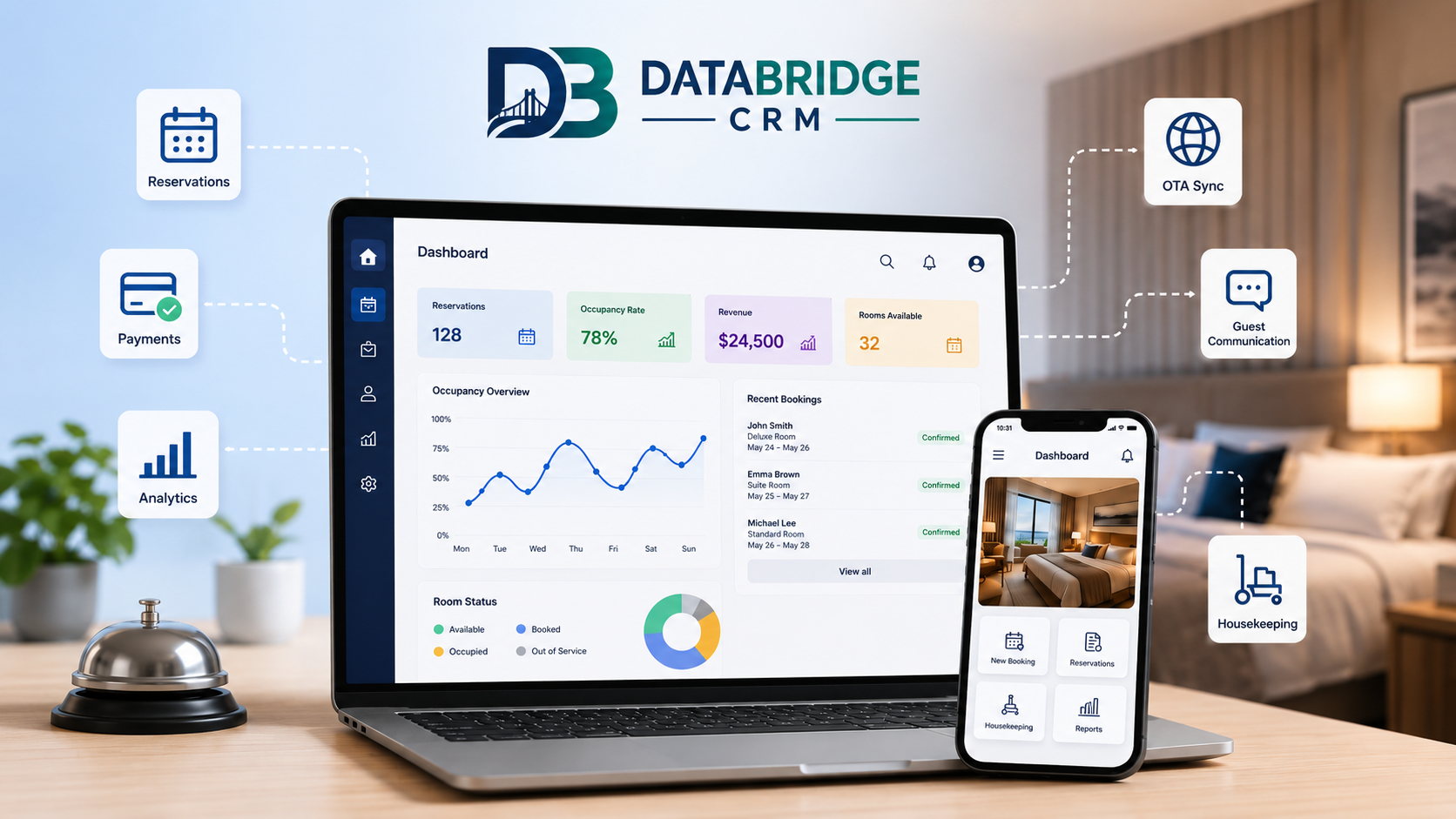
DataBridgeCRM's Hotel CRM is built around these operational realities — bookings consolidated across channels, front desk and housekeeping coordination, GST billing with UPI, and guest records that let you reach past guests through WhatsApp rather than paying commission to reach them again.
It sits within our wider platform, so hotel operations connect to customer records, billing, and marketing rather than standing alone. That connection is what turns a guest who stayed once into a guest you can bring back.
Running a hotel and evaluating systems? Book a free demo — and bring your own scenarios, including the awkward ones. Those are the ones worth testing.

