
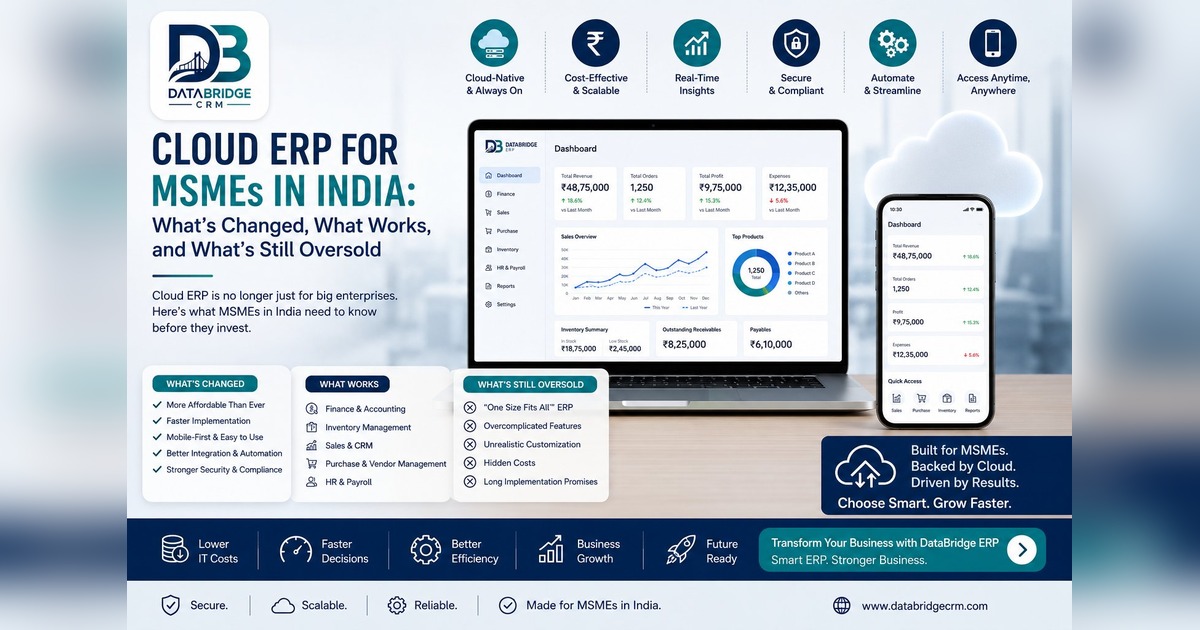
Cloud ERP for Indian MSMEs: What's Real and What's Oversold
Databridge CRM | Powered by Jayshree Technosoft
| databridgecrm.com
India's MSME
sector is massive — 63 million enterprises, 110 million jobs, roughly 30% of
GDP. Yet until recently, the technology available to these businesses was
either too expensive, too complex, or both.
Enterprise
software was built for enterprises. MSMEs made do with Tally, Excel, and
institutional knowledge stored in people's heads.
Cloud ERP has genuinely changed this. But the marketing around it has also outpaced the reality for many businesses. This guide tries to separate both.
What Cloud ERP Actually Means in Practice
For a
traditional MSME — a textile manufacturer in Surat, a metal fabricator in
Ludhiana — ERP means something specific and practical:
• Knowing exactly how much raw material is on
hand without walking to the warehouse
• Knowing the cost of a production run before
it's completed
• Generating a GST invoice automatically when
goods are dispatched
• Letting your CA access accounts without you
emailing a new Excel every week
The
"cloud" part simply means it runs on a server you don't own —
accessible from any device with internet. No installation, no IT
infrastructure, no maintenance.
Why Jaipur MSMEs Are Adopting ERP Faster Than Most
Jaipur's MSME
ecosystem covers gems and jewellery, textiles, IT services, and manufacturing —
each with specific ERP requirements.
Jewellery
businesses need job work tracking and metal accounting. Textile businesses need
production planning and fabric consumption tracking. Services businesses need
project billing.
The
availability of locally-built ERP software
Jaipur that understands these verticals — rather than generic
global tools requiring expensive customisation — has accelerated adoption
significantly. When the implementation partner is local and knows your
industry, the time from purchase to productive use drops dramatically.
The Government Push: Why 2025–2026 Is the Right Time
India's
government push through MSME Samadhaan, Udyam registration, TReDS (invoice
financing), and ONDC (e-commerce) all require digital record-keeping as a
foundation.
An MSME without
transactions in a digital system is increasingly cut off from government
schemes, formal financing, and marketplace opportunities that require
verifiable financial records.
Cloud ERP
adoption is no longer just an operational choice. It's becoming a prerequisite
for accessing the full benefits of being a registered MSME.
Finance and Accounting: The Most Immediate Win
For most Indian
MSMEs, the accounting module delivers the fastest return on investment. The
current alternative — Tally, partially understood by one person, producing
reports nobody fully trusts — is both widespread and fragile.
A cloud
accounting module that produces GST returns automatically, generates real-time
financial statements, and gives the owner an accurate cash position at any
moment is a genuine operational upgrade.
When this
connects to CRM software for small business India
— so sales orders flow into production, production into dispatch, and dispatch
into billing and accounts — the whole business becomes legible in one view.
Databridge CRM
from Jayshree
Technosoft provides this integration specifically at a price
point that makes sense for Indian MSMEs.
Where MSME ERP Implementations Go Wrong
The most common
failure isn't technology — it's process. Businesses that implement ERP without
cleaning up their master data first (customer records, product catalogue,
supplier list) end up running a digital version of the same messy system they
had before.
The second most
common failure is insufficient training. ERP only works if people actually use
it correctly. A purchasing manager who continues calling suppliers for stock
status rather than checking the ERP defeats the purpose.
Five Questions to Ask Before Choosing Any Cloud ERP
• Does it handle your industry's specific
requirements without expensive customisation?
• Does it produce GST-compliant outputs
natively?
• Is there local support available in your
city or region?
• Can your existing staff learn it in a week
or less?
• Does it integrate with your CRM, billing
software, and bank payment gateway?
If any answer
is "it depends" or "we'll need to configure that," factor
the cost of that configuration into your total before signing.
Cloud ERP for Indian MSMEs has moved from innovation to infrastructure. The question in 2026 is no longer whether to adopt it — it's which platform fits your business and how to implement it so it actually changes how you operate.
Databridge CRM | Powered by Jayshree Technosoft
| databridgecrm.com

