
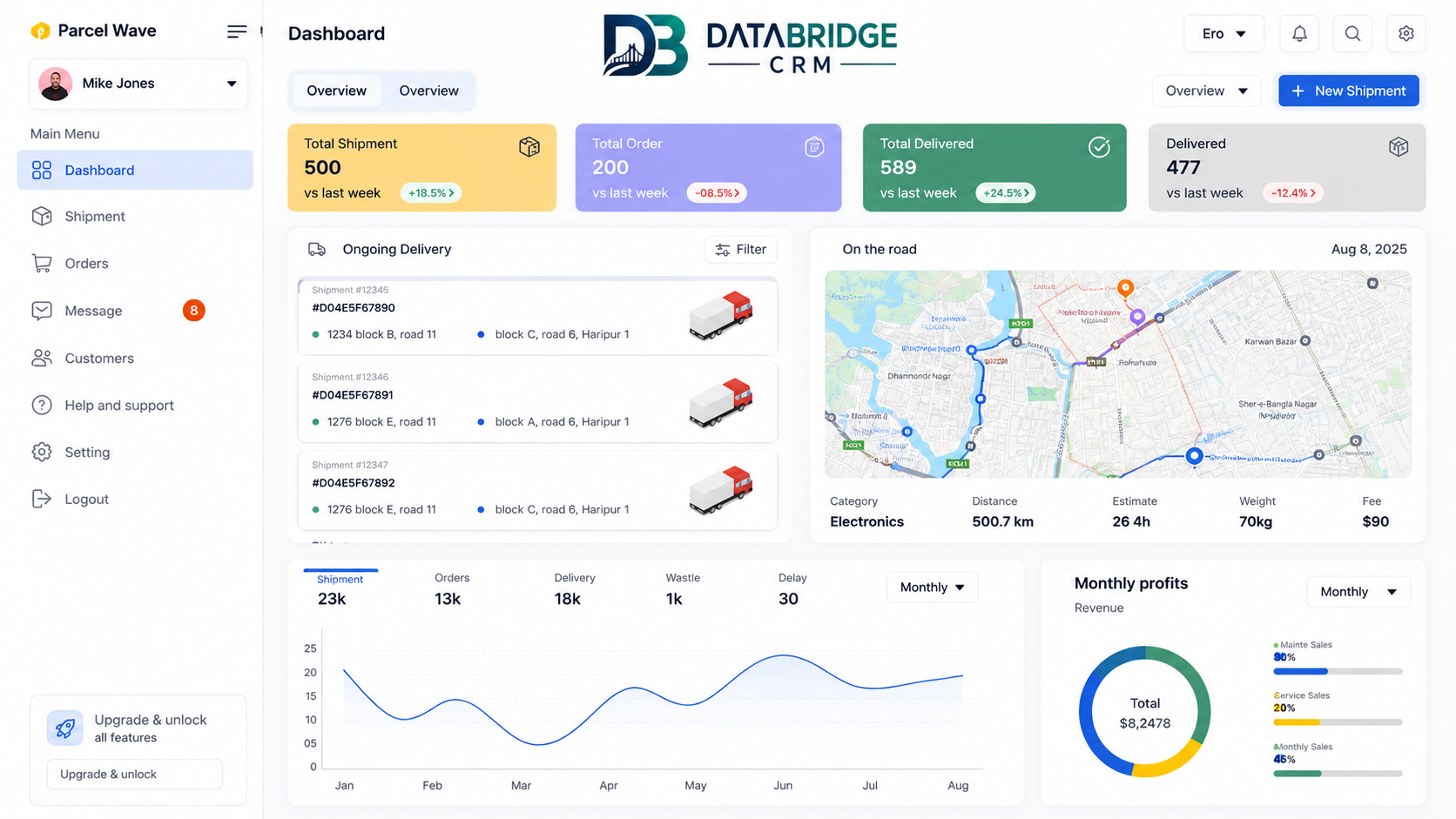
In courier and logistics, the customer's experience is almost entirely about one thing: knowing where their consignment is. Everything else in the operation exists to make that answer available and accurate.
This guide covers what courier management software should handle, what to test before buying, and where logistics businesses lose money without noticing.
The Test That Matters
How long does it take to book a consignment and hand over a receipt?
At a busy counter, this repeats constantly. Sender details, receiver details, weight, destination, service type, payment. If a regular customer's details have to be typed fresh every time, you're losing minutes on every booking.
Test it in the demo with a repeat customer scenario — the system should recognise them and fill most of it automatically.
What Courier Software Actually Needs to Handle
Booking and tracking numbers
Fast consignment entry, automatic tracking number generation, printed receipts and labels, and immediate SMS or WhatsApp confirmation to the sender. That confirmation reduces enquiry calls more than anything else you can do.
Status updates through the journey
Picked up, in transit, at hub, out for delivery, delivered, or attempted. Each update should be enterable from a phone by the person actually doing it — not typed later by someone at a desk from a paper sheet, which is how updates become inaccurate.
Customer-facing tracking
A page where anyone with a tracking number sees current status without calling you. This single feature eliminates a large share of incoming calls, which is real staff time recovered.
Rate calculation
Rates vary by weight, destination, service speed, and customer contract. Corporate clients have negotiated rates; walk-ins pay standard. Volumetric weight matters for bulky lightweight items. If calculating a rate requires a chart on the wall, errors follow.
Cash on delivery handling
A significant share of Indian courier volume. COD amounts collected, reconciled against consignments, and remitted to the shipper. This is where money genuinely goes missing without proper tracking — the amounts collected by delivery staff must reconcile precisely.
Corporate accounts and billing
Regular business clients booking on credit, with monthly consolidated invoices, negotiated rates, and outstanding balances visible. Most courier revenue in many businesses comes from these accounts.
Delivery staff coordination
Assigning consignments to delivery personnel, seeing what's out with whom, and capturing proof of delivery — signature or photo — from a phone.
The Requirements Generic Systems Miss
It must work offline. Delivery staff move through areas with poor connectivity constantly. Status updates and proof of delivery need to capture offline and sync when signal returns. Ask to see this demonstrated.
Everything on a phone. Your delivery staff don't carry laptops. If updating status requires a computer, updates happen hours late or not at all — and inaccurate tracking is worse than no tracking.
WhatsApp for customer updates. Booking confirmation, out-for-delivery notification, delivery confirmation. Indian customers read WhatsApp; SMS increasingly goes unnoticed.
Address handling that tolerates reality. Indian addresses are frequently incomplete, landmark-based, and inconsistently formatted. Systems requiring rigidly structured addresses force staff to enter nonsense to proceed.
Where Courier Businesses Lose Money Invisibly
COD reconciliation gaps. The largest recoverable leak in most courier operations. Amounts collected that don't match amounts remitted, discovered weeks later when the trail has gone cold.
Failed delivery attempts. Each reattempt costs fuel, time, and a delivery slot. Systems that capture accurate contact details and notify recipients before attempting reduce these significantly.
Underweighed or misclassified consignments. Charging by actual weight when volumetric weight applies, or applying the wrong service rate, gives away margin on every booking.
Corporate receivables nobody tracks. Credit clients whose outstanding balance grows quietly because nobody has a clear view of what's due and for how long.
Enquiry calls. Staff time spent answering "where is my parcel" is pure cost that customer-facing tracking eliminates.
What to Test in the Demo
Do these yourself:
Book a consignment for a repeat customer. Calculate a rate for a bulky lightweight item. Assign consignments to a delivery person. Update status from a phone with the internet disconnected, then reconnect and confirm it synced. Record a COD collection and reconcile it. Look up a consignment by tracking number as a customer would. Generate a corporate client's monthly invoice. And produce a report of undelivered consignments older than three days.
Cost Questions Worth Asking
Is pricing per branch, per user, or per consignment? What is the total first-year cost including setup and training? Are SMS and WhatsApp notifications included or charged separately — and at what rate, since volume adds up? What happens when we add branches? And how does support work during peak season?
Our Approach
DataBridgeCRM's Courier CRM is built around these operational realities — fast booking with repeat-customer recognition, tracking numbers with customer-facing status pages, mobile status updates that work offline, COD collection and reconciliation, corporate account billing, and WhatsApp notifications at each stage.
It connects to our wider platform, so consignment data, customer records, billing, and communication work as one system rather than several that need reconciling every night.
Running a courier or logistics business and evaluating systems? Book a free demo — bring your own COD and corporate billing scenarios. Those are where systems either hold up or don't.

