
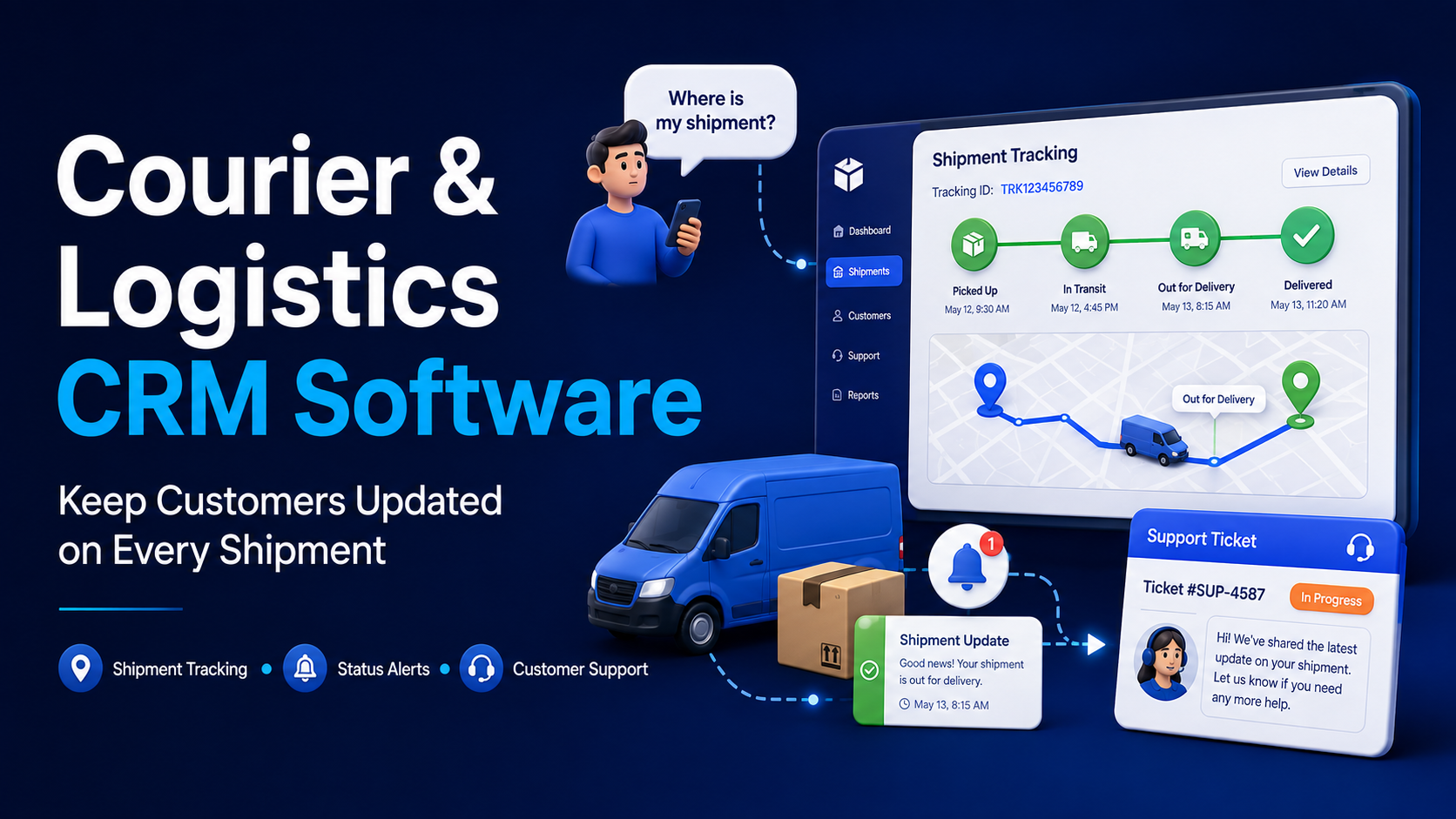
Ask any courier or logistics business what eats up most of their customer support time, and the answer is almost always the same: customers asking where their shipment is. This single question, repeated hundreds of times a day, is usually a sign of a deeper problem — no real-time visibility connecting the shipment's actual status to the customer's experience. Courier CRM software exists to close that gap.
Why Manual Tracking Doesn't Scale
A small courier operation can manually update customers by phone or WhatsApp when volume is low. The moment shipment volume grows, this becomes unsustainable — support staff spend hours each day answering the same status questions, delivery delays go unnoticed until a customer complains, and there's no structured data to identify recurring problem routes or delivery partners.
What Courier and Logistics CRM Should Handle
Real-Time Shipment Status
Automatic status updates — picked up, in transit, out for delivery, delivered — visible to both the business and the customer, without requiring manual status checks or phone calls.
Customer Communication Automation
Automated SMS or WhatsApp updates at each shipment milestone dramatically reduce the volume of "where is my order" inquiries reaching support staff.
Delivery Partner and Route Management
Assigning shipments to delivery staff or partners, and tracking performance by route or partner, helps identify where delays are actually happening.
Billing and Invoicing
Automated billing tied to shipment records, rather than manually reconciling delivery counts against invoices at the end of each billing cycle.
Why Customer Trust Depends on Visibility
In logistics, customer trust is built almost entirely on predictability — knowing when a shipment will arrive, and being informed proactively if something changes. A courier business that provides accurate, automatic status updates builds meaningfully more trust than one that requires customers to ask.
Connecting CRM Data to Operational Decisions
Beyond customer communication, tracking shipment data systematically reveals patterns that are invisible when everything is handled manually — which routes consistently run late, which delivery partners have the best performance, and where bottlenecks are actually occurring. This data becomes genuinely useful for improving operations, not just for answering customer questions.
What to Look for in Logistics CRM Software
- Does it provide real-time status visibility, or just periodic manual updates?
- Can customer communication be automated at key shipment milestones?
- Is billing connected to actual shipment records, or handled separately?
- Does it surface performance data by route or delivery partner?
DataBridgeCRM's Courier and Logistics Solution
DataBridgeCRM includes shipment tracking, automated customer communication, and billing tools built specifically for courier and logistics businesses, connected to the same CRM platform running the rest of the business — part of the broader all-in-one system used across 25+ industries, starting at ₹50/day.
Reduce "Where Is My Order" Calls Automatically
If manual shipment tracking is overwhelming your support team, book a free demo of DataBridgeCRM's courier and logistics CRM and see automated tracking in action.

