
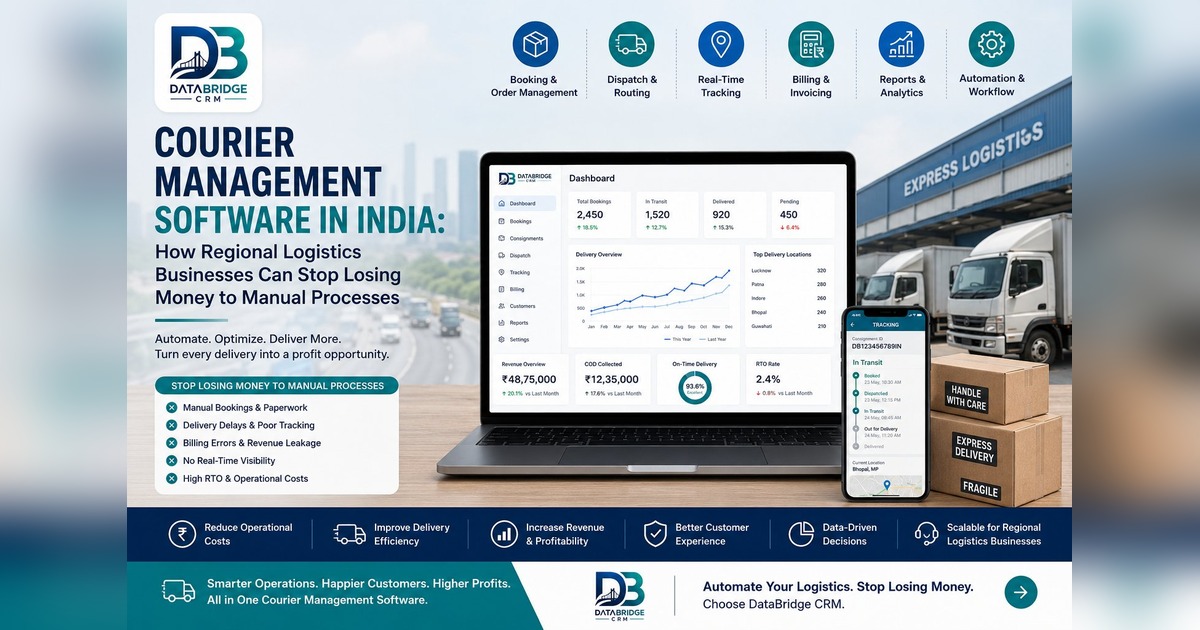
Courier Management Software in India: How Regional Logistics Businesses Can
Stop Losing Money
Databridge CRM | Powered by Jayshree Technosoft
| databridgecrm.com
India's
logistics industry is growing at over 10% annually — driven by e-commerce,
quick commerce, and formalising supply chains. The large national players have
invested heavily in technology.
But regional
and city-level courier businesses — the ones handling last-mile delivery,
hyperlocal B2B logistics, and small manufacturer shipments — are often still
running on manual consignment books, WhatsApp coordination, and end-of-day cash
settlement.
This is exactly where courier management software makes the most difference.
The Consignment Tracking Problem
In a manual
courier operation, the consignment note is a paper slip. If it gets lost,
misread, or misfiled, the tracking history disappears with it.
When a customer
calls asking where their package is, the answer is usually a phone call to the
delivery person — who may not answer, and may not remember one specific
consignment out of the 60 they're carrying.
Digital
consignment management fixes this at source:
• Each consignment gets a unique ID, scanned
at pickup, each transit hub, and delivery
• Customer receives an SMS or WhatsApp update
at each stage automatically
• Operations manager has a real-time view of
every shipment in the network
• Problems — delays, damage, misrouting — are
visible immediately, not when the customer complains
Route Optimisation: The Daily Inefficiency Most Firms Ignore
A delivery
person covering 50 drops without route optimisation covers roughly 30–40% more
distance than necessary. In a fuel-cost-sensitive business with thin margins,
that's not a small problem — it's the difference between a profitable route and
a loss-making one.
Route
optimisation software considers traffic patterns, delivery windows, vehicle
capacity, and geographic clustering to build the most efficient sequence.
In Indian
cities, where traffic varies dramatically by time and area, this is
particularly valuable. A delivery person who starts the day with an optimised
route delivers more consignments, consumes less fuel, and finishes earlier —
every day.
Client Billing: Where Courier Businesses Lose Money Quietly
Courier billing
is deceptively complex. A single consignment might attract:
• Volumetric weight billing
• Fuel surcharge
• Remote area surcharge
• GST at varying rates depending on service
type
Calculating all
of this manually for hundreds of consignments per day, per client, is
error-prone — and the errors almost always favour the client, not the courier
company.
Billing POS software India designed
for logistics automates all of this. Rate cards are configured per client.
Consignment data flows directly into billing. Invoices are generated with full
breakdowns. And every surcharge is captured — including the ones that get
forgotten in manual billing.
Client Relationship Management in B2B Logistics
B2B courier
clients are high-value and high-maintenance. They want visibility, consistency,
and fast resolution when something goes wrong.
Managing these
relationships without a system means relying on whoever happens to be handling
the account that day — which leads to inconsistent service and client
attrition.
A CRM software for small business India
built into your courier platform tracks every client interaction:
• Service issues raised and how they were
resolved
• Billing queries and their status
• Rate renegotiations in progress
• Complete account history accessible to any
team member instantly
Cash-on-Delivery Management: The Complexity Most Platforms Underestimate
For courier
businesses handling e-commerce deliveries, COD creates a specific daily
challenge. Cash collected by delivery staff needs to be accounted for, remitted
to merchants, and reconciled against delivery records — across multiple staff,
every day.
Proper COD
management tracks expected versus actual collection, manages the remittance
cycle back to merchants, and flags discrepancies in real time rather than at
monthly reconciliation. For businesses where COD is 30–50% of deliveries, this
module alone eliminates significant financial leakage.
E-Commerce Integration: Now a Baseline Requirement
Any courier
business handling e-commerce volumes needs to integrate with Shopify,
WooCommerce, Amazon Seller Central, or Meesho. Without integration, order data
is manually entered — which is slow, error-prone, and doesn't scale past a few
dozen orders a day.
Databridge CRM
by Jayshree
Technosoft provides courier management with native e-commerce
integrations, automated consignment creation, client billing, COD management,
and real-time tracking — all connected to CRM for client relationship
management. Starting at ₹50/day.
The courier businesses that grow in India's logistics boom won't necessarily be the ones with the most vehicles. They'll be the ones with the best operational visibility.
Databridge CRM | Powered by Jayshree Technosoft
| databridgecrm.com

