
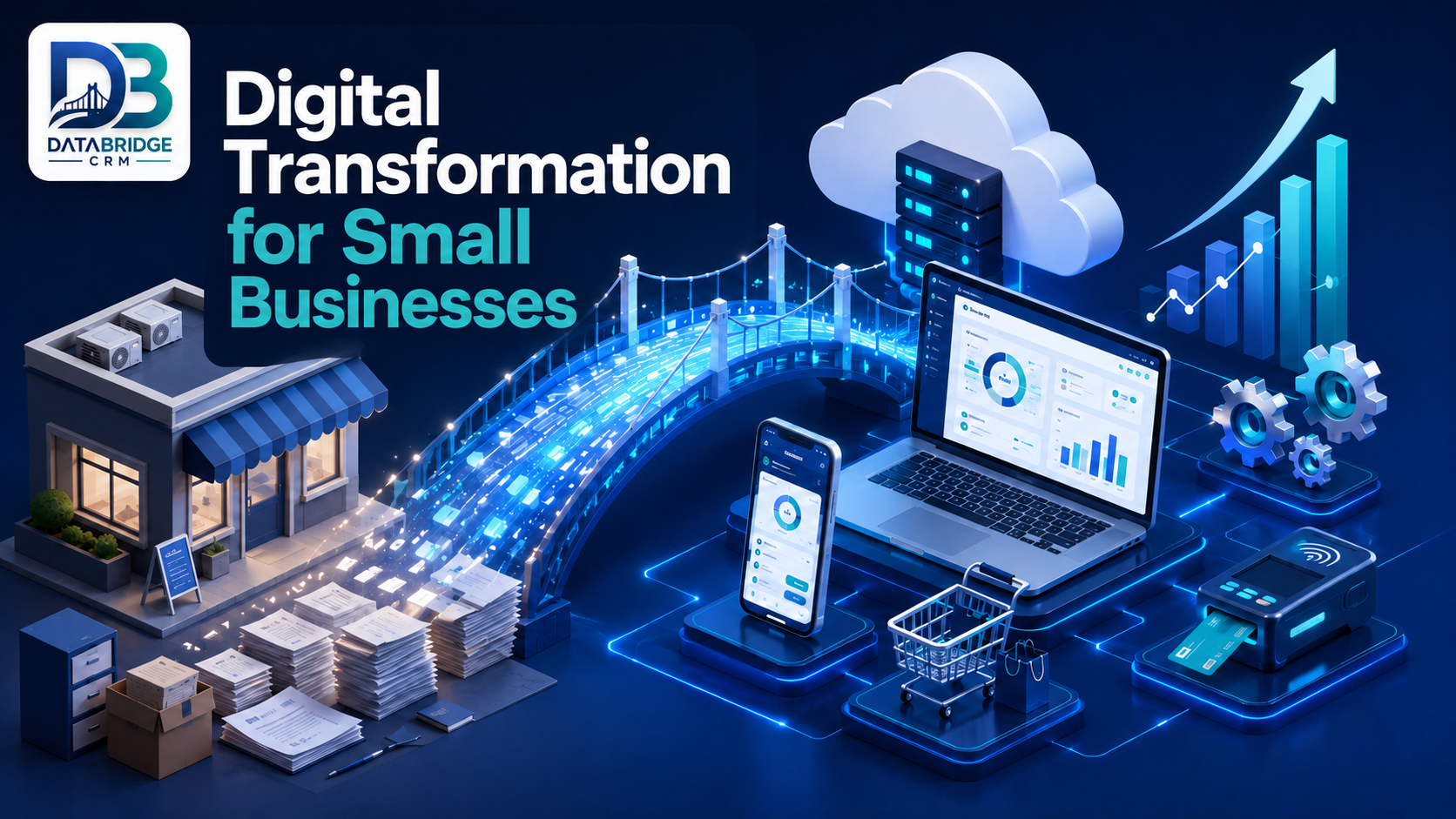
Digital transformation does not mean replacing everything at
once. It means improving the customer and employee journey through connected,
measurable technology.
Begin With Outcomes, Not Software
Digital transformation consulting for small business should
start with a business goal: faster sales follow-up, accurate inventory,
smoother billing, stronger customer service or better management visibility.
Buying multiple applications without a shared plan can make work more
fragmented.
Document the current customer journey and internal workflow.
Identify delays, duplicate entry, missing information and tasks dependent on
one person. Rank these issues by financial impact, customer impact and
implementation effort.
Build the Core in Phases
Phase one should establish reliable customer and operational
data. Depending on the business, this may involve CRM, ERP, POS, inventory or
an industry-specific management module. Phase two can connect communication and
marketing. Phase three can introduce more advanced automation and AI once the
underlying data is dependable.
DataBridgeCRM combines cloud CRM and ERP solutions with
workspace, website, marketing, communication and AI capabilities. This
all-in-one direction can help businesses reduce fragmentation, but each company
should activate only the tools that support its immediate priorities.
Integration and Adoption Decide the Result
A digital system should move information across departments
with minimal duplicate entry. CRM ERP integration services can connect customer
demand with billing, inventory and operations. Communication integrations can
keep messages and follow-ups attached to relevant records.
Employees need to understand how the new workflow makes
their job easier. Involve representatives from each affected team, test
realistic scenarios and provide role-specific training. Appoint an internal
owner who can monitor data quality, answer routine questions and coordinate
improvements.
Measure, Learn and Expand
Choose a small set of metrics before launch, such as
response time, conversion rate, stock accuracy, processing time, campaign
turnaround or hours of manual work. Review them at regular intervals and
collect employee feedback.
Digital transformation is a continuous improvement program,
not a single installation. With a phased roadmap and the right IT consultancy
services in Jaipur, a small business can modernize at a manageable pace while
building a connected foundation for future growth.
Conclusion
If your business is evaluating digital transformation
consulting for small business, begin with a clear requirement map and a
demonstration based on your actual workflow. DataBridgeCRM brings CRM, ERP,
workspace, marketing, communication and AI capabilities into a connected
ecosystem designed to help growing businesses work more efficiently.
Call to action: Book a personalized DataBridgeCRM demo to
discuss your current process, priority challenges and suitable modules.
Frequently Asked Questions
What is digital
transformation for a small business?
It is the planned use of connected technology to improve
customer experience, internal processes, data visibility and business
decision-making.
Should every system
be replaced at once?
Usually no. A phased rollout focused on the highest-impact
process reduces risk and makes adoption easier.
What should be
integrated first?
Prioritize systems that repeatedly exchange the same
information, such as CRM with billing, inventory, ERP or customer communication
tools.

