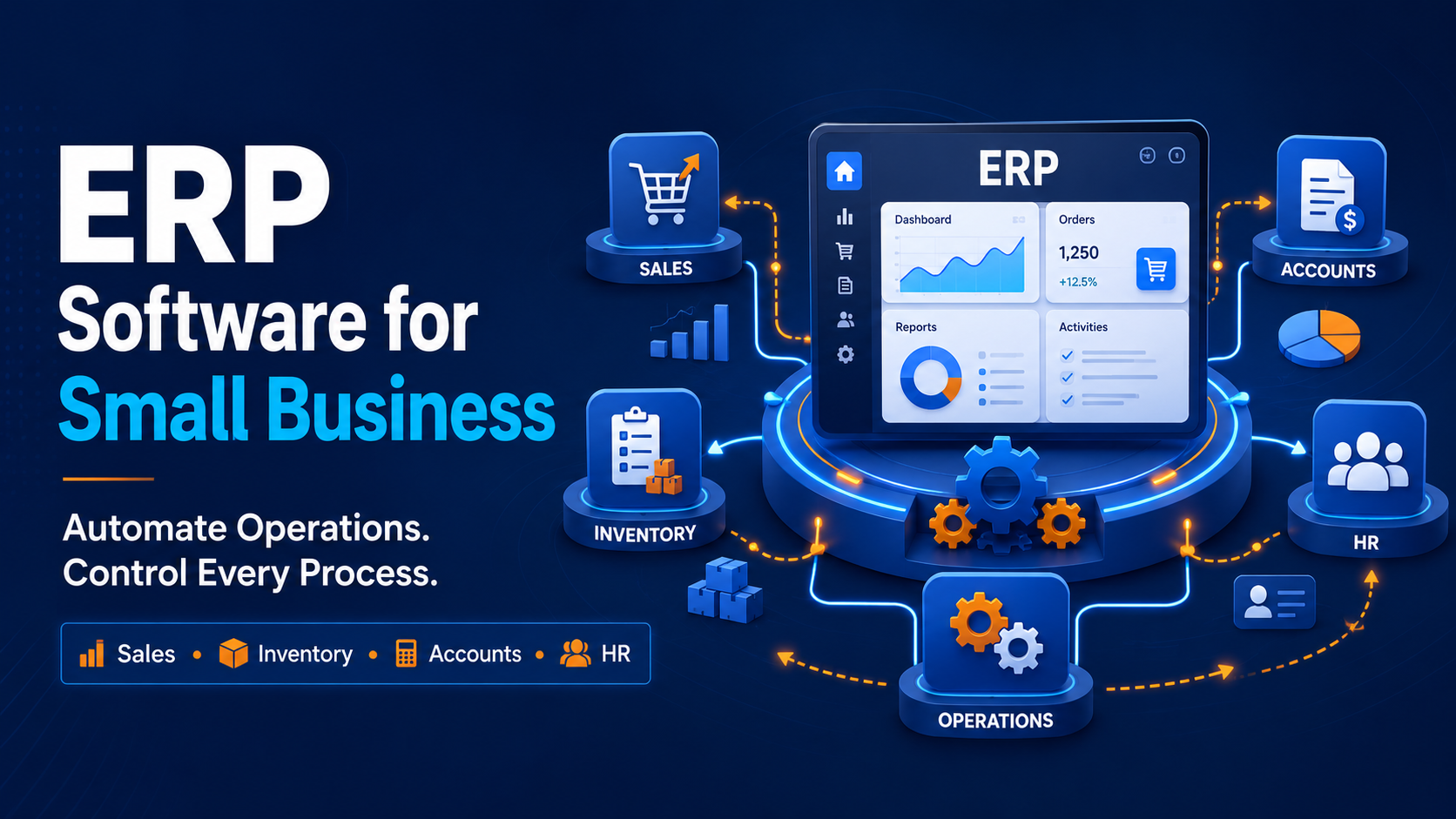
As a small business grows, so does the number of tools it depends on — one app for billing, another spreadsheet for inventory, a separate CRM for customers, and a WhatsApp group for team coordination. Each tool solves one problem but creates a new one: none of them talk to each other. This is the exact gap that ERP software for small business is built to close.
What ERP Actually Means for a Growing Business
ERP — Enterprise Resource Planning — sounds like something only large corporations need. In practice, any business managing inventory, billing, staff, and customers benefits from a business automation software that keeps all of this in one dashboard, instead of five disconnected ones.
Signs Your Business Has Outgrown Manual Systems
- Your team re-enters the same customer or order data in more than one place
- Inventory counts in your system don't match what's actually on the shelf
- Billing and sales numbers take hours to reconcile at month-end
- Different staff members use different tools, so no one has the full picture
If two or more of these sound familiar, a unified ERP software setup will likely save more time than any single point solution.
Core Modules a Small Business ERP Should Cover
Billing and POS
Real-time billing that automatically updates inventory and sales records, instead of manual entry after the fact.
Inventory Management
Live stock visibility across locations, with automatic alerts before you run out of fast-moving items.
Customer and Order Management
A connected CRM layer so sales, support, and billing teams are all looking at the same customer history — not separate silos.
Reporting and Dashboards
Owners and managers should be able to see sales, expenses, and performance in real time, without waiting for someone to compile a spreadsheet.
Why Industry-Specific ERP Matters
A restaurant's ERP needs (tables, kitchen orders, daily specials) look nothing like a hospital's (patient records, appointment scheduling, billing compliance) or a courier company's (shipment tracking, delivery status). Generic ERP software forces every business into the same mold. An ERP software India provider built around specific industries — retail, hospitality, healthcare, education, logistics — fits the way your team actually works from day one.
DataBridgeCRM's Approach to ERP and Business Automation
DataBridgeCRM combines ERP, CRM, and billing into a single cloud platform, with dedicated modules for hotels, hospitals, schools, restaurants, garages, courier companies, and e-commerce businesses. Rather than forcing businesses to adapt to rigid enterprise software, the platform is built around ₹50/day accessible pricing with enterprise-grade security, 99.9% uptime, and 24/7 support — designed specifically for Indian SMBs, not just large corporations.
What to Check Before You Choose ERP Software
- Does it combine billing, inventory, and customer data in one place?
- Is it built around your industry, or is it a generic template?
- What's the actual uptime and support response time?
- Can your team learn it without weeks of training?
Bring Your Business Onto One System
Running sales, billing, and operations from disconnected tools slows you down every single day. Book a free demo of DataBridgeCRM's ERP and business automation platform and see how much manual work can be eliminated.

