
Garage software fails for a specific reason: it's designed for a desk, and a garage doesn't have one. The people who need to record what happened are under a vehicle with dirty hands, and the job details end up on a scrap of paper that reaches the billing counter hours later — incomplete.
This guide covers what workshop management software should handle, what to test before buying, and where garages lose money without noticing.
The Test That Decides It
How does a mechanic record that they used two litres of oil and replaced a filter?
If the answer involves walking to a computer, it won't happen consistently. If it's a few taps on a phone, it will. Everything about garage software profitability depends on this one workflow, because unrecorded parts and labour are unbilled parts and labour.
Test it in the demo, on a phone, as a mechanic would.
What Workshop Software Actually Needs to Handle
Vehicle history, not just customer history
The vehicle is the record. What was done last time, which parts were fitted, what was flagged for next visit, and what the customer declined. When a vehicle returns after eight months, that history is what lets you serve them properly — and what justifies your recommendations.
Lookup by registration number, not by customer name.
Job cards that reflect real work
Complaints reported by the customer, inspection findings, work approved, parts used, labour recorded, and work deferred. Real jobs change mid-way — additional issues found, customer approving some items and declining others. Software that assumes the job is fixed at intake doesn't survive.
Estimate and approval flow
Inspection produces an estimate, the customer approves some items, work proceeds on those. Capturing that approval — ideally on WhatsApp with a record — prevents the most common garage dispute: "I never agreed to that."
Parts inventory linked to jobs
Parts issued to a job reduce stock and appear on the bill automatically. Without this link, parts leave the store and never reach the invoice.
Labour rates and mechanic assignment
Which mechanic worked on what, for how long. Useful for billing, and useful for knowing who is actually productive.
Billing with GST
Parts and labour taxed correctly, split payments, and invoices customers can use for insurance or company claims.
Service reminders
The most valuable feature for garage revenue, and the most commonly missing. Due-service reminders based on date or estimated running, sent on WhatsApp. A customer reminded returns; a customer not reminded goes wherever is convenient.
The Requirements Generic Systems Miss
It must work on a phone, with dirty hands, in poor light. Large touch targets, minimal typing, and photo capture rather than written descriptions where possible.
Photos matter more than text. Damage on arrival, the worn part removed, work completed. Photos prevent disputes and justify charges better than any description. A system that makes photo capture awkward won't get used for it.
It must work when the internet drops. Job entry and billing cannot stop.
Mechanic technology comfort varies. If the person doing the work can't operate it in under a minute, the paper slip comes back.
WhatsApp for everything customer-facing. Estimates, approvals, job-ready notifications, and service reminders. This is where Indian customers respond.
Where Garages Lose Money Invisibly
Unbilled parts and labour. The single largest leak. Work done and parts fitted that never reached the invoice because they were recorded on paper that got lost or was never transcribed. Systems that capture at the point of work rather than at the counter recover this directly.
Parts inventory nobody tracks. Stock leaving without a corresponding job. Without linkage, this gap is invisible.
Customers who never come back. Most garages have no idea which vehicles are due for service. Every unreminded customer is revenue going to a competitor — and reminders cost almost nothing.
Disputes about approved work. Without recorded approval, arguments end in discounts.
Estimates that become invoices without adjustment. Additional work performed but billed at the original estimate because nobody updated it.
What to Test in the Demo
Do these yourself:
Look up a vehicle by registration number and see its full history. Create a job card, then add extra work discovered mid-job. Send an estimate and record customer approval of only some items. Issue parts from stock to a job on a phone. Add photos of damage. Bill the job with GST and split payment. Disconnect the internet mid-job-entry. And produce a list of vehicles due for service this month.
Cost Questions Worth Asking
Is pricing per user, per bay, or per workshop? What is the total first-year cost including setup, parts catalogue entry, and training? Who enters our existing parts inventory? Are WhatsApp notifications included or charged separately? And what does support look like on a Saturday, which is when garages are busiest?
Getting Started Sensibly
Don't attempt to enter your entire parts catalogue before going live. Start with your fastest-moving parts, begin creating job cards immediately, and add the rest as they're used. Billing works from day one and the catalogue completes over a few weeks.
And start with job cards and billing before inventory. Getting work recorded properly delivers the biggest immediate gain; stock tracking follows once the habit exists.
Our Approach
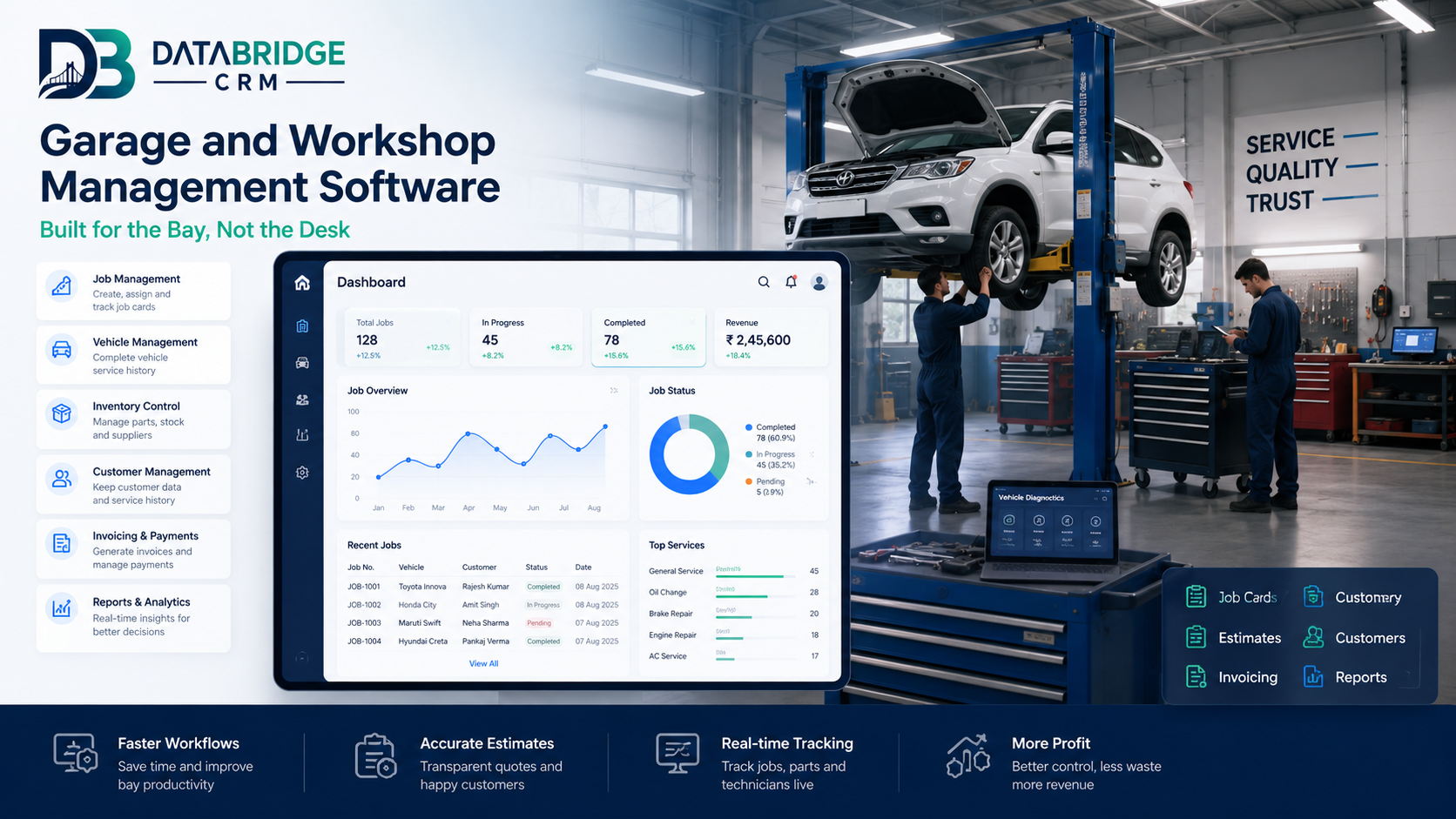
DataBridgeCRM's Garage CRM is built around workshop realities — vehicle-based history lookup, job cards that handle mid-job changes, mobile parts issue and photo capture, WhatsApp estimates and approvals, GST billing, and automated service reminders that bring customers back.
It connects to our wider platform, so job data, parts inventory, customer records, and communication work together — which means the vehicle serviced eight months ago is one you can actually reach when it's due again.
Running a garage or workshop and evaluating systems? Book a free demo — and test it on a phone, the way your mechanics would actually use it.

