
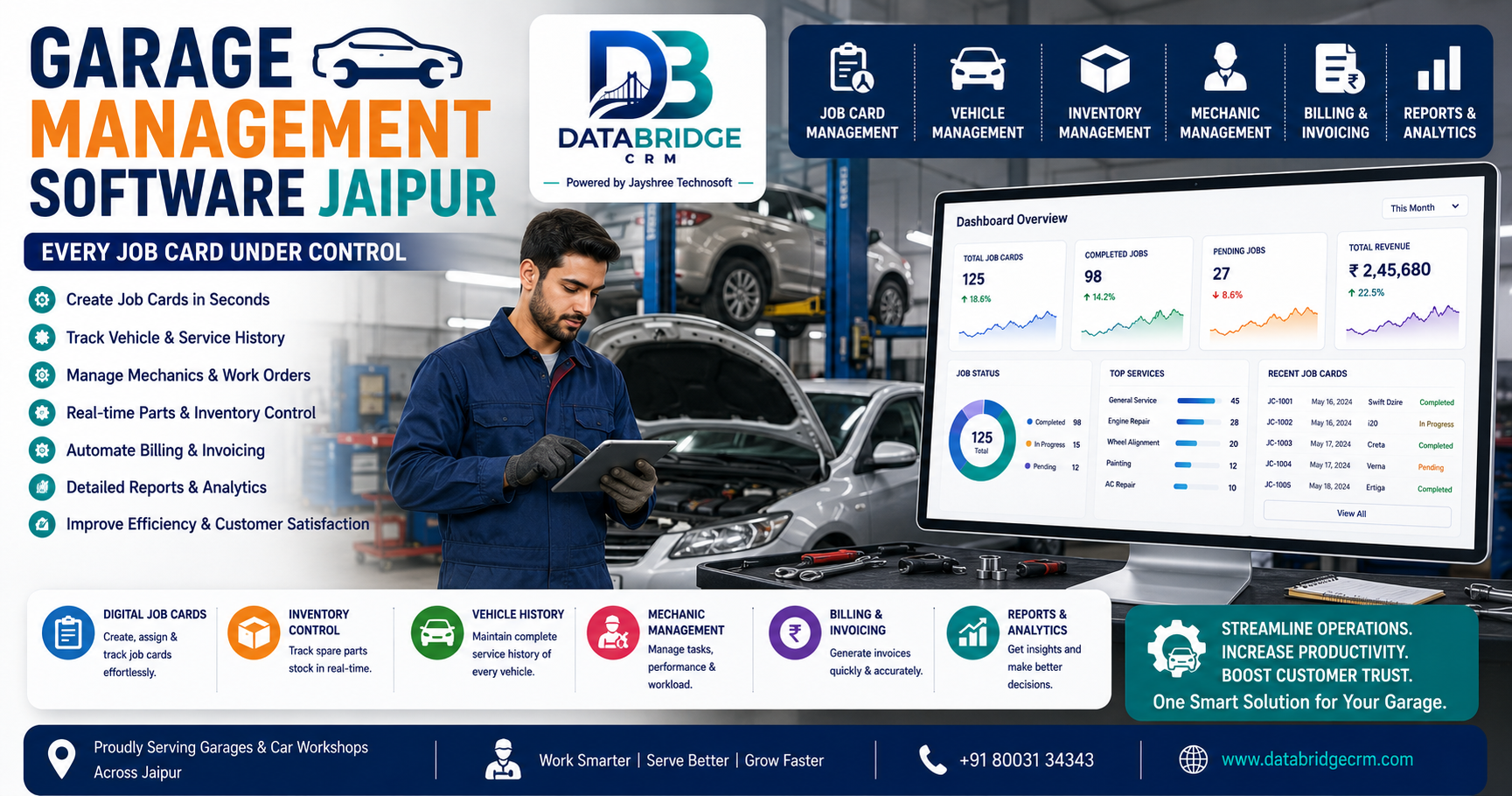
The automotive
repair industry in India is one of the most relationship-driven businesses in
the country. When a customer trusts you with their vehicle, they're trusting
you with something that gets them to work, takes their kids to school, and
represents a significant financial investment.
That trust is built on transparency, reliability, and communication. The problem is that most Indian garages manage this trust through memory, handwritten job cards, and phone calls — systems that are charming at small scale and catastrophic as the business grows.
The Problems Every Growing Garage Owner Recognises
There's a very
specific set of challenges that every garage owner in India faces as their
business grows past a certain volume:
•
Job cards that get misplaced or are illegible by the
end of the day
•
Customers calling to ask for an update — and nobody
knowing which stage their car is at
•
Parts ordered for one vehicle accidentally used on
another
•
Billing that doesn't capture everything done on a
vehicle
•
No record of what was serviced on a particular vehicle
last time it came in
•
Mechanics whose productivity is unknown because there's
no tracking
These aren't
operational failures. They're the natural limit of running on paper and memory.
What a Garage Management System Actually Does
A garage
management system is essentially a job card manager, customer history tracker,
parts inventory, and billing system — all connected.
When a vehicle
comes in, a digital job card is created with the vehicle number, customer
contact, reported issue, and assigned mechanic. As the technician works, they
log what they've done and which parts they've used. The customer can receive an
SMS update at each stage.
When the job is
complete, the invoice is generated automatically from the job card — labour,
parts, GST — without any manual calculation. And the full service history is
stored against the vehicle number forever.
Customer Communication That Builds Loyalty
The garage
businesses that retain customers most effectively aren't always the best
mechanics. They're the ones that communicate best.
Using garage management software
india with integrated WhatsApp notifications:
•
Customer gets a message when their vehicle is received
•
Customer gets an update when the diagnosis is complete
with the estimated cost
•
Customer approves the work digitally before it starts
•
Customer gets a notification when the vehicle is ready
for pickup
•
Three months later, an automatic service reminder goes
out
This is the level of professional communication that turns a one-time visitor into a lifetime customer.
Parts Inventory and Procurement
Parts
management is where garages lose significant money. Parts ordered that aren't
needed. Parts used that aren't billed. Stock levels that nobody tracks until a
job stalls because a part is out.
An integrated
parts inventory connects to your job cards. When a part is logged on a job
card, it deducts from stock automatically. When stock falls below a set level,
an alert is triggered. Every part used is on the invoice.
GST Billing for Garages: More Complex Than It Looks
Garage billing
involves multiple GST treatments — labour attracts one rate, parts another. A
customer who supplies their own parts changes the calculation. Insurance-claim
jobs have documentation requirements.
Getting this
wrong consistently is both a customer service problem and a compliance issue.
Proper billing software handles it automatically based on how the job is
categorised when the job card is created.
Databridge CRM's Garage CRM by Jayshree Technosoft is built specifically for Indian automotive repair businesses — with job cards, parts inventory, WhatsApp updates, and GST-compliant billing from ₹50/day.
Databridge CRM | Powered by
Jayshree
Technosoft |
databridgecrm.com

