Every business collects customer data, manages bookings or orders, and handles billing — but the way a hotel does this looks nothing like how a hospital, school, or garage does it. That's the core problem with generic CRM software: it treats every business the same way. Industry-specific CRM software solves this by building the workflow around your actual operations, not a generic contact list.
Why Generic CRM Software Falls Short
A CRM designed for a general "any business" use case usually needs heavy customization — new fields, workarounds, and manual processes just to fit your daily operations. That customization takes time, costs money, and often still doesn't get the workflow quite right. Industry-specific CRM software skips this step because the structure is already built around businesses like yours.
What Industry-Specific CRM Looks Like in Practice
Hotel Management Software
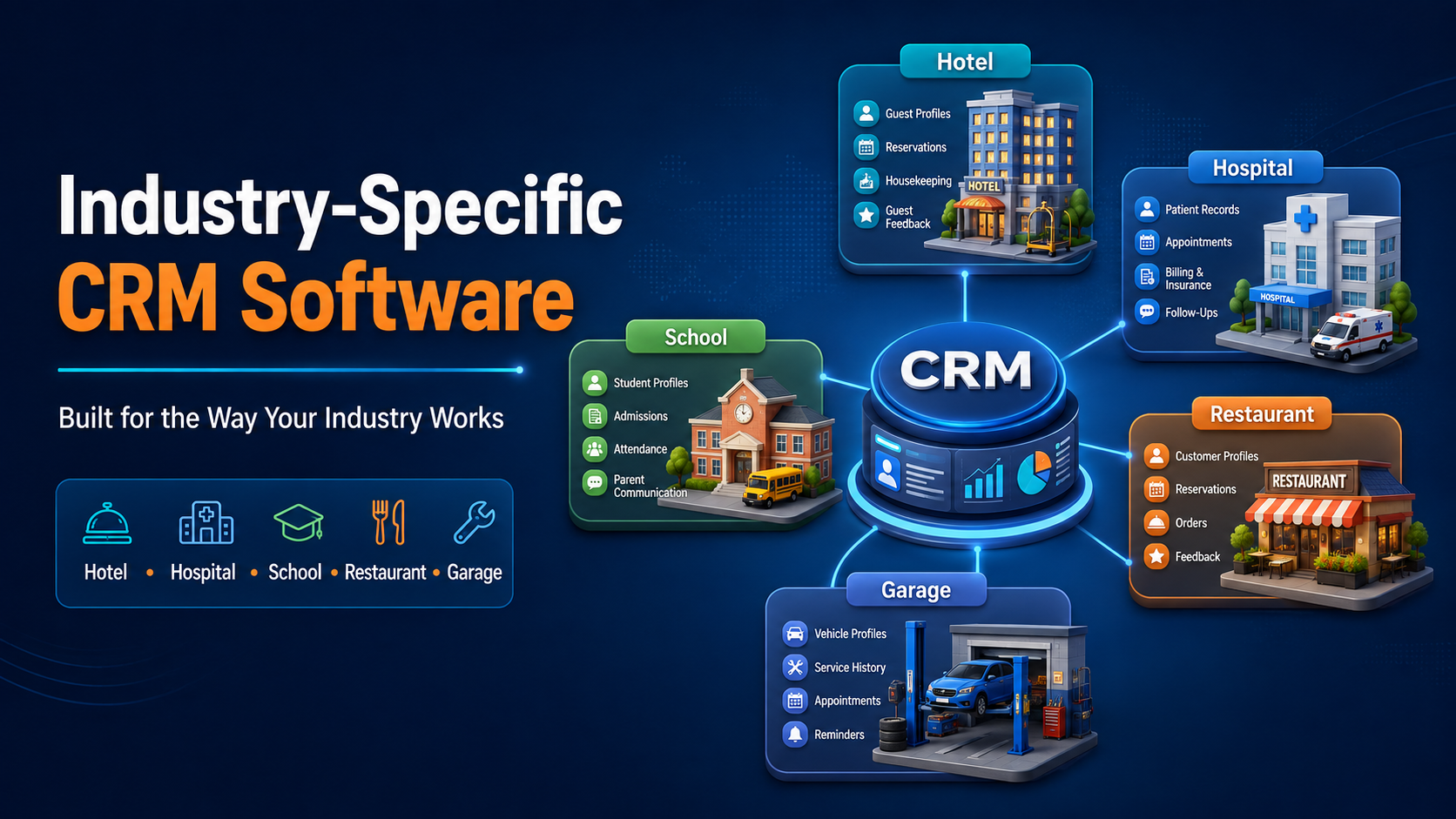
Bookings, room availability, guest check-in/check-out, and billing — all connected so front desk staff always see real-time occupancy instead of juggling separate booking sheets.
Hospital & Clinic CRM
Patient records, appointment scheduling, and billing built around healthcare workflows, so clinical and administrative staff aren't relying on disconnected paper files or spreadsheets.
School CRM / ERP
Admissions, fee tracking, attendance, and parent communication in one system, replacing the mix of registers and spreadsheets most institutions still depend on.
Restaurant CRM
Table management, kitchen order tracking, and billing designed around how a restaurant floor actually operates during a rush.
Garage Management Software
Vehicle job cards, repair status tracking, and customer history, so a garage can quote and bill accurately without relying on memory or paper job sheets.
Courier & Logistics CRM
End-to-end shipment tracking from pickup to delivery, giving both the business and customer real-time visibility into order status.
The Real Benefit: Less Training, Faster Adoption
The biggest hidden cost of generic software isn't the subscription price — it's the weeks your team spends figuring out how to force their daily work into a system that wasn't built for them. Industry-specific CRM software cuts this significantly, because the fields, workflows, and reports already match how your staff actually work.
One Platform, Multiple Industries
DataBridgeCRM offers dedicated CRM and ERP modules for hotels, hospitals, schools, restaurants, garages, courier companies, and e-commerce businesses — all built on the same underlying platform, so switching between industry needs doesn't mean switching software providers. Businesses across 25+ industries currently use the platform, backed by 24/7 support and 99.9% uptime.
How to Know If You Need Industry-Specific CRM
Ask yourself:
- Are you customizing a generic CRM every time your workflow changes?
- Does your team maintain separate spreadsheets alongside your current software just to track industry-specific details?
- Would a new employee understand your current system in a day, or does it take weeks?
If the answer points to "yes, we're forcing our business into the wrong tool," it's worth seeing what a purpose-built alternative looks like.
See Your Industry's CRM in Action
Whether you run a hotel, hospital, school, restaurant, or garage, book a free demo of DataBridgeCRM and see a walkthrough built around your specific business, not a generic template.

