
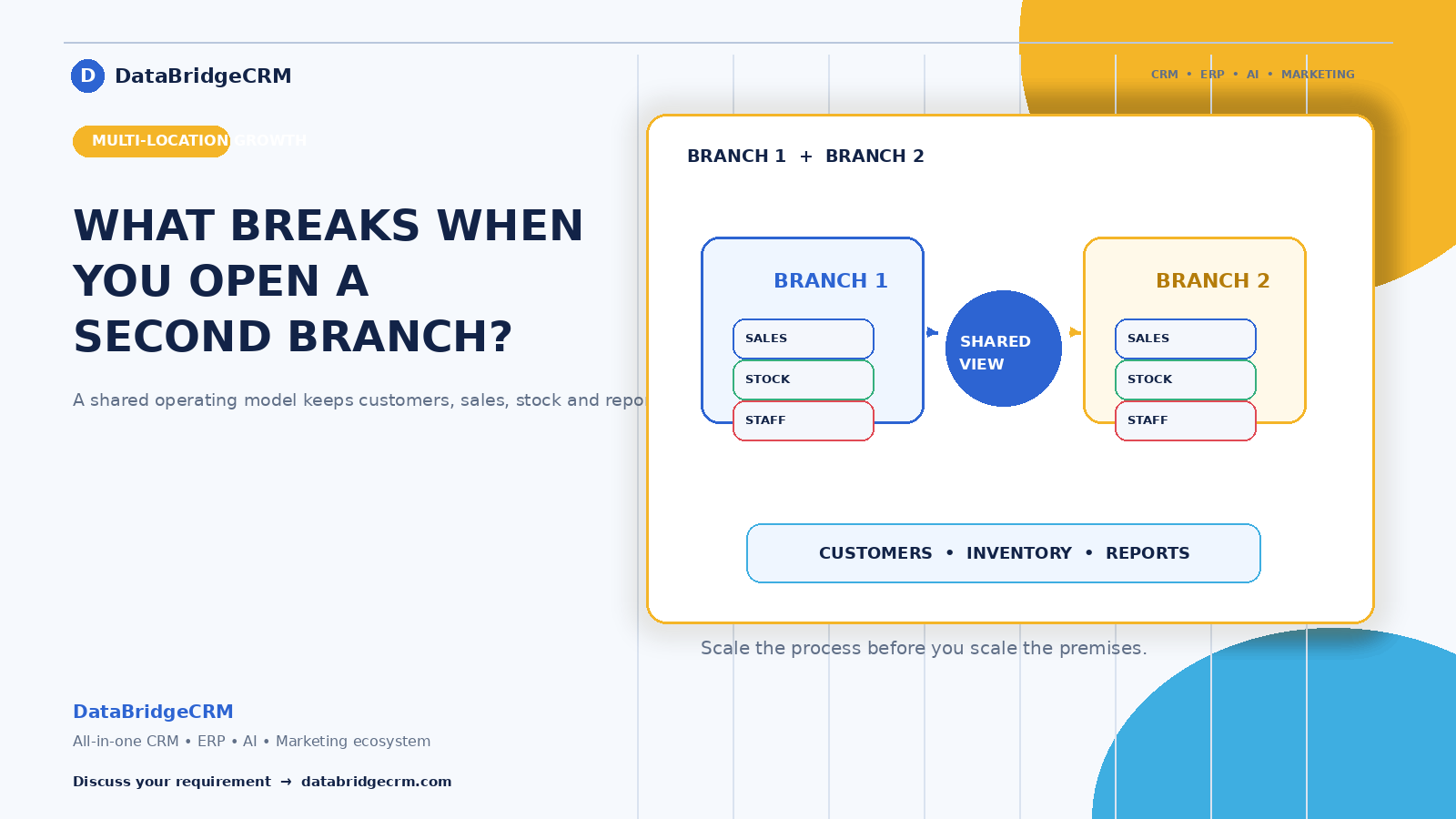
The second branch is where most business systems break. Not because the work is harder, but because everything that ran on the owner being present now has to run without them.
This is about what changes, and what has to be in place before it does.
What Actually Breaks at Branch Two
A single-location business runs on visibility. The owner sees the stock, knows the customers, notices when something is wrong, and makes decisions on the spot.
None of that survives distance. What replaces it has to be a system, and businesses that open a second branch without building one discover the same problems in the same order:
Nobody knows total stock. Each branch tracks its own, nothing is visible centrally, and stock sits idle at one location while another runs out of the same item.
Numbers arrive late and don't reconcile. Each branch reports separately, someone combines spreadsheets, and the totals never quite match.
Pricing and discounts drift. Different rates at different branches, discretionary discounts nobody records, and customers noticing the inconsistency.
Customer records fragment. A customer known at one branch is a stranger at another. Their history, preferences, and outstanding balance don't travel.
Cash and collections become opaque. Money handled at each location with reconciliation happening days later, if at all.
Staff accountability blurs. Who approved that discount, who cancelled that bill, who wrote off that stock.
The Test Before You Open
Ask yourself: if I don't visit either branch for a week, what would I not know?
Sales, stock levels, collections, pending orders, customer complaints. If the honest answer is "most of it," you're not ready to open — or you're ready to open and about to spend six months firefighting.
The systems should exist before the second branch, not be built in response to it.
What Multi-Location Software Has to Do
One view, and separate views
The owner needs consolidated numbers across all branches. Each branch manager needs their own branch, and shouldn't see others' details unless you want them to. Both simultaneously.
Stock visible across locations
Total stock, branch-wise stock, and — critically — the ability to transfer between branches with a proper record. Stock transfers done informally are where inventory accuracy dies.
Centralised pricing with controlled flexibility
Rates set centrally so they're consistent, with defined limits on what a branch can discount and a recorded reason when they do. Complete freedom produces drift; complete rigidity produces workarounds.
Shared customer records
A customer served at any branch is recognised at every branch, with their history and outstanding balance visible. This is what makes multi-location feel like one business to the customer rather than several unrelated shops.
Branch-wise reporting that compares
Not just each branch's numbers, but comparison — which branch is performing, which product sells where, where collections are slow. This is what makes multiple locations manageable rather than merely multiple.
Role-based access
Branch staff see their branch. Managers see their branch's details. The owner sees everything. Accounts sees financials across all. Getting this wrong in either direction causes problems — too open and you lose control, too restrictive and staff can't work.
The Requirements Generic Systems Miss
Each branch must work when its internet drops. One location losing connectivity cannot stop billing there, and the data must sync when it returns. Ask for a demonstration.
Everything on phones. Owners check numbers between other things. Branch managers move around. A system requiring a desktop gets checked weekly instead of daily.
Staff turnover varies by location. A system needing formal training will be operated badly at whichever branch just lost two people.
Pricing that scales sensibly. Ask specifically what a third and fourth branch cost. Per-location pricing that seemed reasonable at two can become the reason you delay opening a fifth.
Where Multi-Branch Businesses Lose Money
Stock imbalance. The same item overstocked at one location and unavailable at another, both invisible without central visibility.
Uncontrolled discounts. Branch-level discretion that nobody tracks, adding up substantially across locations and months.
Slow collections at distance. Receivables at a branch the owner doesn't visit weekly, growing quietly.
Duplicate purchasing. Each branch ordering independently, losing volume advantage and creating excess.
Shrinkage that can't be traced. Without branch-wise stock tracking linked to sales, you know something is wrong and not where.
What to Test in a Demo
Do these yourself:
Look at consolidated sales, then drill into one branch. Transfer stock between branches and check both reduce and increase correctly. Bill a customer at branch A, then look them up at branch B. Set a price centrally and check it applies everywhere. Apply a discount as branch staff and see whether it's recorded with a reason and a name. Check what a branch manager can and cannot see. Disconnect one branch's internet mid-billing. And produce a branch comparison report.
Before Opening the Next Location
A short checklist that saves months:
Systems working properly at the existing branch — problems multiply rather than resolve when replicated. Processes written down rather than living in the owner's head. Stock, pricing, and customer data centralised. Clear reporting you actually look at. And defined authority: what a branch manager can decide alone, and what needs approval.
Businesses that expand on systems grow. Businesses that expand on the owner's presence hit a ceiling at two or three locations.
How We Handle Multi-Location
DataBridgeCRM supports multi-branch operations across our CRM, billing, and inventory modules — consolidated and branch-wise views, stock transfers with records, centralised pricing with controlled flexibility, shared customer records, and role-based access so each person sees what their role requires.
Because it's one connected platform, adding a branch is a configuration rather than a separate implementation — which matters when the third and fourth locations come faster than the second did.
Planning to expand, or managing multiple locations that don't feel like one business? Book a free demo — bring your branch scenarios, including the stock transfer that always goes wrong.

