
India has more
WhatsApp users than any other country in the world. Over 500 million people
check it multiple times a day. It's where they chat with family, coordinate
with colleagues, and — increasingly — interact with businesses.
If your
business isn't using WhatsApp as a marketing channel, you're choosing to
communicate through channels your customers find less convenient.
But there's a right way and a costly wrong way to approach this.
The Open Rate That Changes Everything
Email
newsletters in India average around 18–22% open rates. SMS is around 30–40%.
WhatsApp messages from businesses that customers have opted into? Consistently
above 90%.
That number
alone makes WhatsApp the most valuable marketing channel available to Indian
SMEs. A message that 9 out of 10 customers actually read changes what's
possible with a small marketing budget.
What Most Businesses Are Doing Wrong
The most common
WhatsApp "marketing strategy" for Indian small businesses looks like
this: the owner or a staff member sends messages from a personal number to a
broadcast list of contacts.
This approach
has a short lifespan. WhatsApp actively detects and bans personal numbers
sending promotional content at scale. It also provides zero analytics, no
automated responses, no proper opt-out mechanism, and no way to scale beyond
256 contacts per broadcast.
It's not
marketing. It's messaging. There's a significant difference.
How WhatsApp Marketing Software Changes the Game
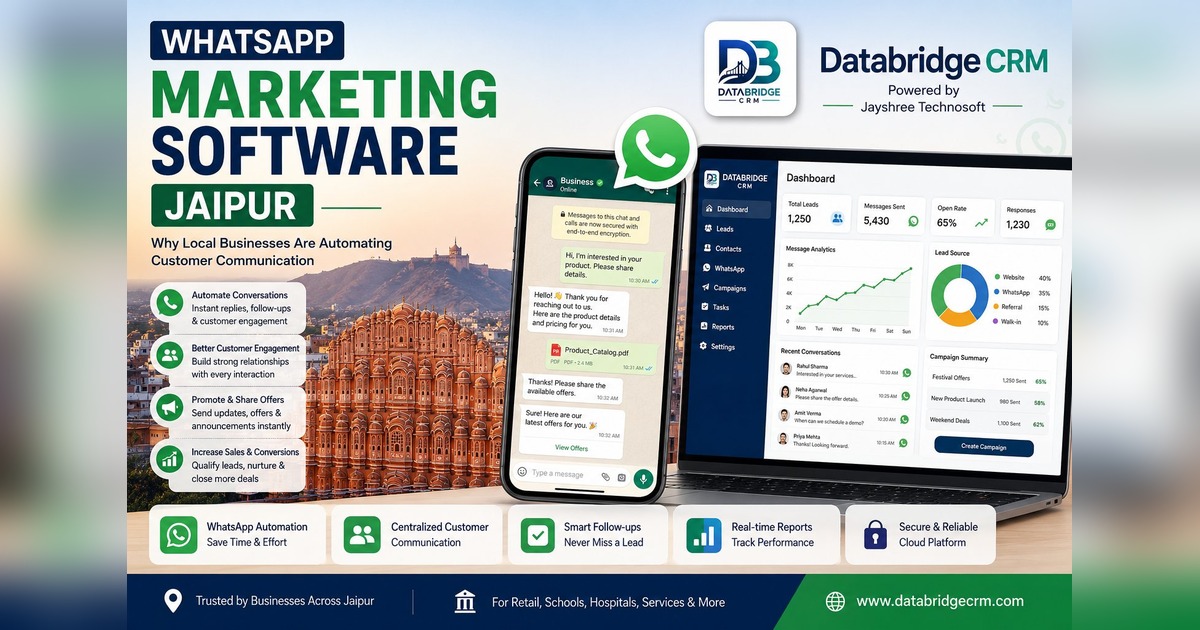
Proper whatsapp marketing
software india built on the official WhatsApp Business API does
things a personal account can't:
•
Send messages at scale with proper opt-in compliance —
no ban risk
•
Segment customers by purchase history, location, or
behaviour and send relevant messages
•
Set up automated journeys — welcome messages, order
confirmations, delivery updates
•
Track message delivery, opens, and link clicks with
real analytics
•
Handle incoming replies through a shared inbox that
multiple team members can manage
•
Schedule campaigns for the right time — not whenever
someone remembers to send
Automation That Runs While You Sleep
The most
valuable WhatsApp automations are the ones triggered by real events in your
business:
•
Customer makes a purchase → instant receipt and order
confirmation
•
Stock of a product the customer previously bought comes
back → automatic notification
•
Customer hasn't purchased in 60 days → re-engagement
message with a relevant offer
•
Customer's birthday → personalised offer sent
automatically
•
Appointment tomorrow → reminder sent the evening before
None of these
require a staff member to remember to send them. They fire automatically based
on what happens in your CRM and billing system.
Compliance in 2026: What's Changed
WhatsApp's
commercial messaging policies have tightened significantly. Businesses sending
messages without proper DLT registration (for transactional messages) or
without correct opt-in documentation face account suspension.
The businesses
that have invested in proper WhatsApp marketing tools through Databridge CRM by Jayshree
Technosoft are operating with verified business profiles, official
API access, and full compliance — which means no disruption when policies
tighten further.
Combining WhatsApp with Your Broader Marketing Strategy
WhatsApp works
best when it's connected to your other channels. SMS for guaranteed delivery on
critical notifications. Email for longer content and formal communication.
WhatsApp for the personal, conversational interactions that build
relationships.
When all three run from the same platform with shared customer data, you get the right message to the right customer through the right channel — every time.
Databridge CRM | Powered by
Jayshree
Technosoft |
databridgecrm.com

