
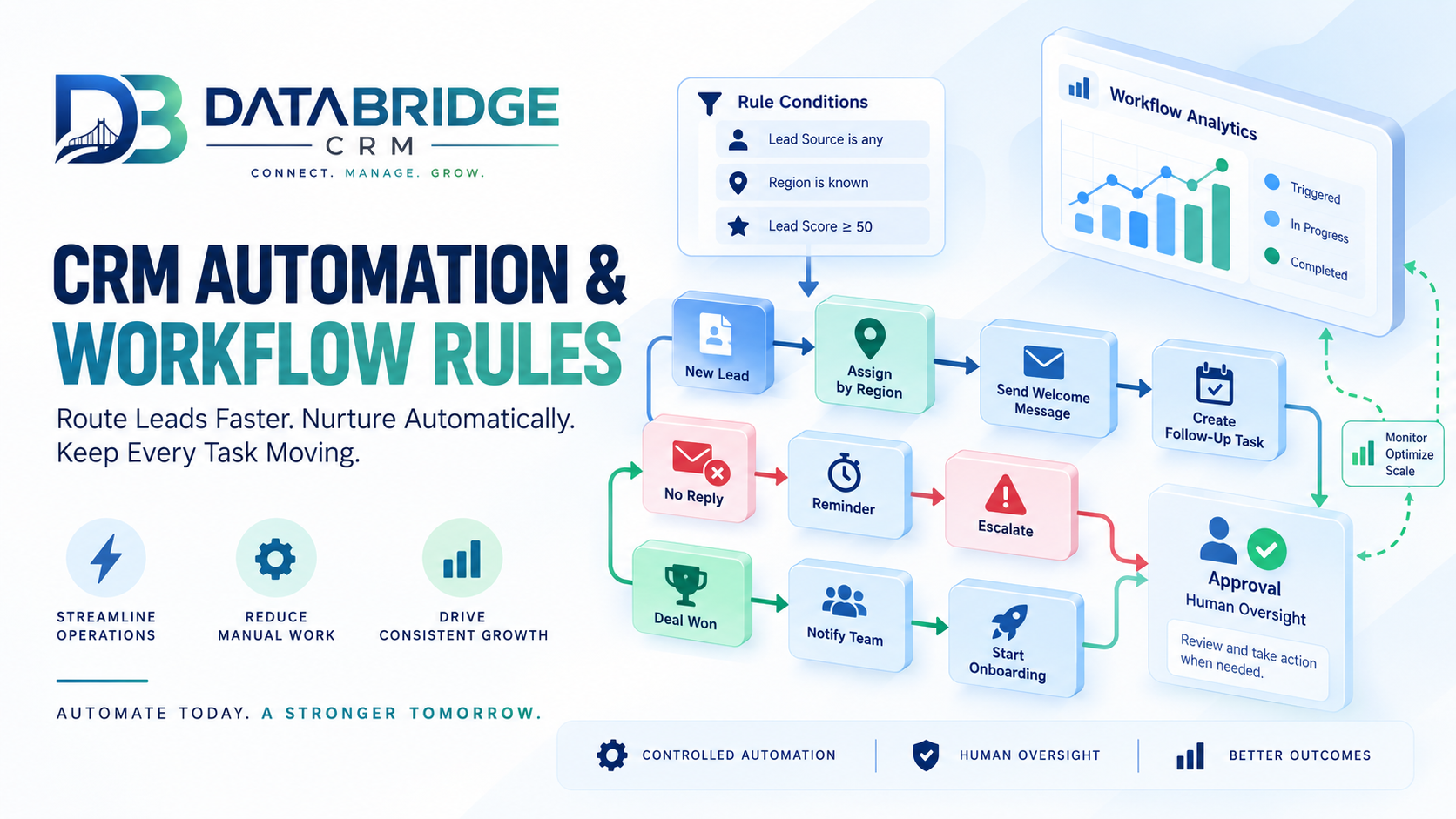
Plenty of CRMs do a fine job storing customer information but still require someone to manually decide every next step — who follows up, when, and with what message. The real value of a CRM shows up once CRM automation and workflow rules start handling these repetitive decisions automatically, freeing staff to focus on the interactions that genuinely need human judgment.
Why Manual Follow-Up Doesn't Scale
A small number of leads can be tracked and followed up manually without much trouble. As lead volume grows, relying entirely on staff remembering to follow up at the right time becomes unreliable — some leads get contacted promptly, others slip through, and there's no consistency in how quickly or thoroughly different team members respond.
What CRM Automation Should Actually Handle
Automatic Lead Routing
Assigning new leads to the right team member based on defined rules — territory, product interest, workload — without requiring someone to manually review and distribute every incoming lead.
Triggered Follow-Up Sequences
Automatically sending a follow-up message, scheduling a reminder, or escalating a lead that hasn't been contacted within a defined time window, rather than relying entirely on individual staff discipline.
Status-Based Actions
Moving a lead automatically through pipeline stages based on specific triggers — a form submission, a completed call, a signed agreement — keeping the pipeline accurate without requiring constant manual updates.
Automated Notifications
Alerting the right person immediately when a high-value lead takes a specific action, or when a deal has been inactive for too long, ensuring important moments don't get missed simply because no one happened to check.
Where Automation Genuinely Helps vs. Where It Shouldn't Replace Judgment
Automation works best for repetitive, rules-based tasks — routing, reminders, status updates — where consistency matters more than individual judgment. Complex negotiations, sensitive customer situations, or nuanced sales conversations still benefit from human judgment; a well-designed automation strategy identifies which parts of a process genuinely benefit from automation and which need a person's attention.
Why Poorly Designed Automation Backfires
Automation rules that are too aggressive — sending too many automated messages, triggering actions based on poorly thought-out conditions — can feel impersonal or create a worse experience than manual handling would have. Good automation design starts with understanding the actual process deeply, not just automating for the sake of automating.
Common Automation Use Cases That Deliver Real Value
- New lead welcome sequences that begin the moment a lead is captured, before a human has even had a chance to respond
- Abandoned inquiry follow-up for leads that went quiet partway through the sales process
- Renewal and repeat purchase reminders based on customer history and typical purchase cycles
- Internal escalation when a deal or support ticket has been inactive longer than it should be
What to Look for in CRM Automation Capability
- Can automation rules be customized to your actual sales or service process, not just generic defaults?
- Does automation trigger based on real customer actions and data, not arbitrary timers alone?
- Is there a clear path for automated processes to escalate to a human when needed?
- Can automation rules be adjusted as your process evolves, without needing developer involvement each time?
DataBridgeCRM's Automation and Workflow Tools
DataBridgeCRM includes configurable automation for lead routing, follow-up sequences, and status-based workflow actions, connected to the same CRM data driving the rest of the business — part of the broader all-in-one platform starting at ₹50/day, helping small teams operate with the consistency of a much larger support and sales operation.
Let Your CRM Actually Work for You
If your team is still manually managing follow-ups and lead routing, book a free demo of DataBridgeCRM's automation tools and see what consistent, rules-based automation can take off your team's plate.

