
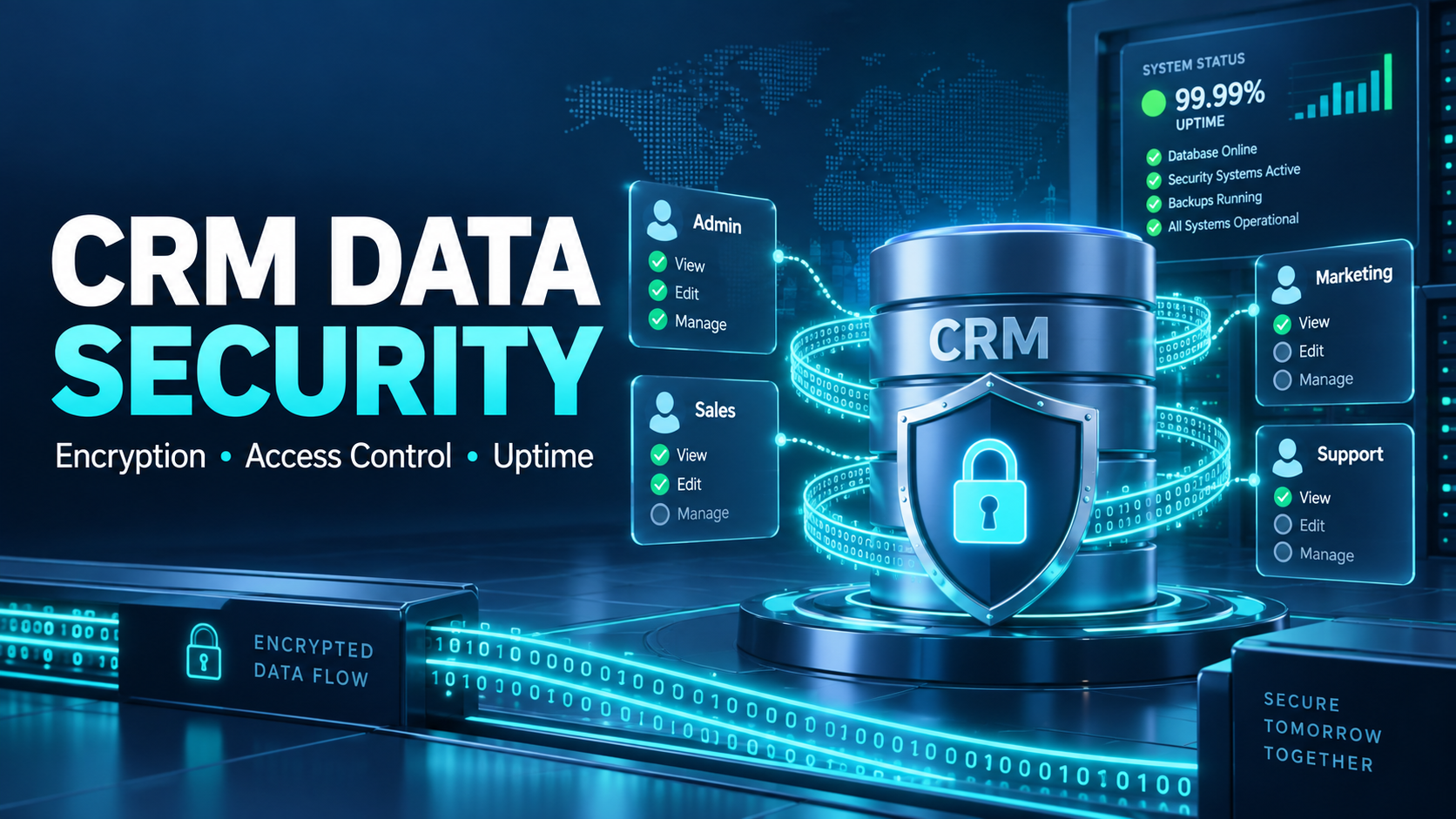
A CRM holds some of the most sensitive information a business has — customer contact details, purchase history, sometimes payment information. Yet many small businesses choose CRM software based almost entirely on price and features, without asking a basic question: what actually happens to this data if something goes wrong? CRM data security deserves the same scrutiny as any other major business decision.
Why Small Businesses Are Often More Exposed, Not Less
Large enterprises typically have dedicated IT security teams and compliance budgets. A small business usually doesn't — meaning a data breach isn't just an inconvenience to remediate, it can be genuinely business-threatening, both financially and in terms of customer trust that's difficult to rebuild.
What Real CRM Data Security Should Include
Encryption of Data at Rest and in Transit
Customer data should be encrypted both while stored and while being transmitted between the CRM and any connected tools — unencrypted data sitting in a database is a significant, avoidable risk.
Proper Access Controls
Not every team member needs access to every piece of customer data. Role-based access controls ensure staff only see the information relevant to their specific job, reducing both accidental exposure and insider risk.
Regular Backups
Reliable, regular backups protect against data loss from technical failures, accidental deletion, or ransomware — a CRM without a proper backup strategy risks losing years of customer history in a single incident.
Uptime and Infrastructure Reliability
Security isn't only about preventing breaches — reliable infrastructure that stays operational is also part of protecting the business, since downtime during critical periods (sales, customer service) has real operational and financial cost.
Why This Matters More for Businesses Without Dedicated IT Staff
A small business owner evaluating CRM options often isn't equipped to independently audit a platform's security infrastructure. This makes it especially important to choose a provider that takes on this responsibility seriously as part of the platform itself, rather than leaving security entirely up to the business to configure and maintain on their own.
Questions to Ask Before Choosing a CRM Provider
- Is customer data encrypted both at rest and in transit?
- Does the platform support role-based access control, or does everyone get the same level of access by default?
- What's the actual uptime track record, and is it documented?
- Are regular backups included, and how quickly can data be restored if something goes wrong?
- What happens to your data if you decide to leave the platform — can you export it fully?
Why "Cheap" CRM Software Can Be a False Economy
A significantly underpriced CRM platform sometimes cuts costs specifically in security infrastructure — fewer redundancies, weaker access controls, less investment in uptime reliability. The cost of a security failure or extended downtime can easily exceed whatever was saved through a cheaper subscription.
DataBridgeCRM's Approach to Security and Reliability
DataBridgeCRM is built with enterprise-grade security and 99.9% uptime, backed by 24/7 support, so small businesses get infrastructure-level protection without needing their own dedicated IT security team. This is treated as a core part of the platform, not an optional add-on, across all modules — CRM, ERP, billing, and marketing tools alike.
Choose CRM Software That Takes Your Data Seriously
If you're evaluating CRM platforms and want to understand what real security and reliability should look like, book a free demo of DataBridgeCRM and ask about the infrastructure behind the features.

