
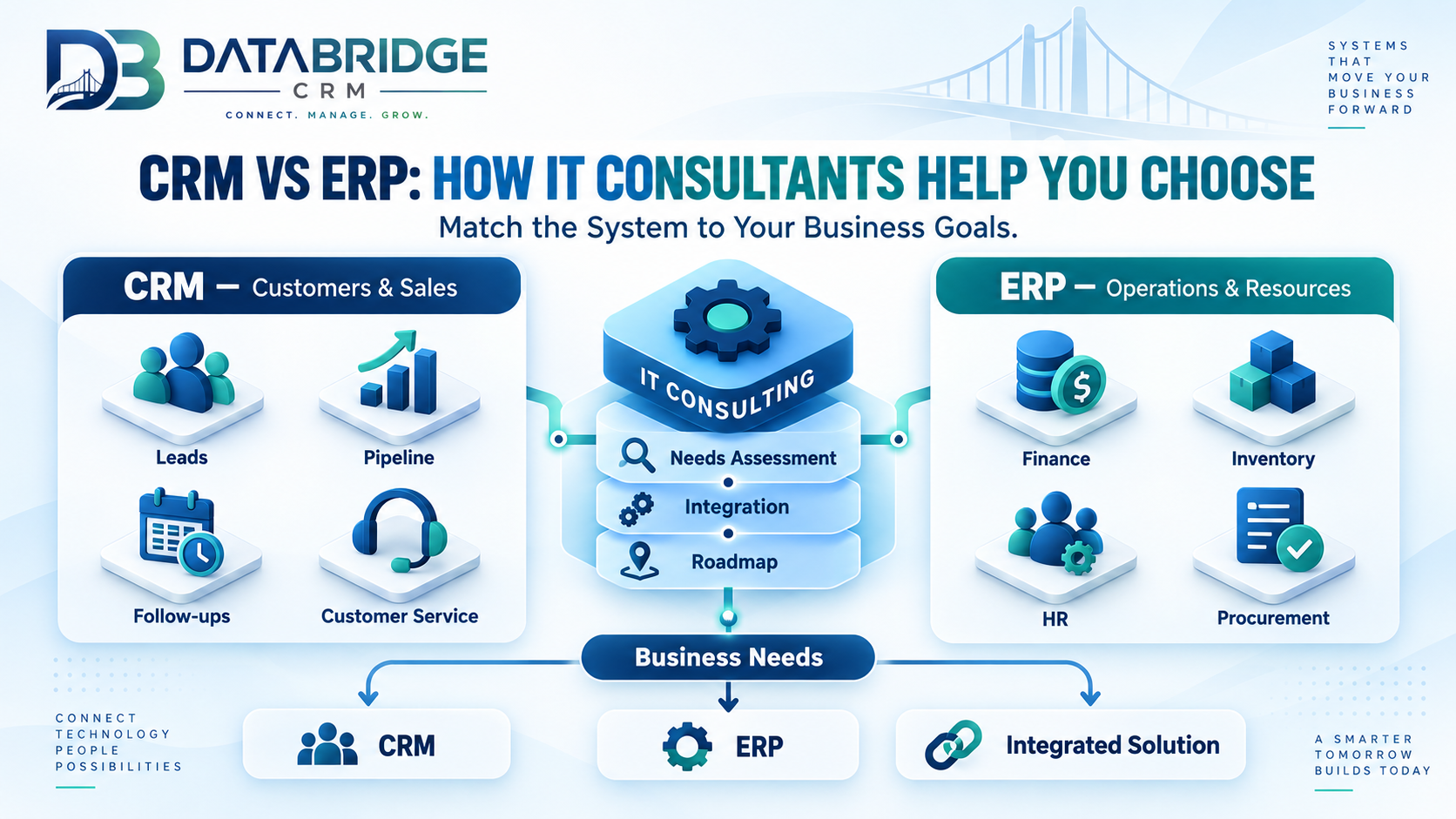
"Do I need a CRM or an ERP?" is one of the most common questions business owners ask an IT consultant. The two are often confused, but they solve very different problems — and picking the wrong one can waste months of setup time and money.
CRM vs ERP: The Core Difference
- CRM (Customer Relationship Management) focuses on your customer-facing operations — leads, sales pipelines, follow-ups, and customer service.
- ERP (Enterprise Resource Planning) focuses on internal operations — inventory, accounting, procurement, HR, and resource planning across departments.
A restaurant tracking table bookings and repeat customers needs strong CRM features. A manufacturing unit tracking raw materials, stock, and multi-department workflows leans heavily on ERP. Many growing businesses eventually need both, working together.
Why This Decision Needs Expert Input
Choosing between CRM and ERP — or figuring out how much of each you need — isn't something most business owners should have to research alone. This is where enterprise resource planning consulting adds real value:
- Workflow mapping — understanding how your team actually operates before recommending software
- Right-sizing — avoiding paying for enterprise-grade ERP features a small business doesn't need
- Integration planning — making sure CRM and ERP share data instead of running in silos
- Migration support — safely moving existing customer and business data into the new system
Industry Examples
- Hotels typically need a CRM-heavy setup for bookings and guest relationships — see how Hotel CRM solutions handle this.
- Retailers and garages often need combined CRM + inventory/ERP features — like Garage Management Software that tracks both customers and job cards.
- Schools and hospitals need ERP-style administrative modules layered with CRM-style parent/patient communication — such as School CRM or Hospital CRM.
How a Good IT Consultant Approaches CRM/ERP Implementation
A structured CRM ERP implementation process usually looks like this:
- Discovery call to understand business size, industry, and pain points
- Recommending the right modules (not the entire product suite by default)
- Data migration and staff training
- Post-launch support and adjustments as the business grows
Final Word
You don't need to become a software expert to make the right choice — you need the right IT consultancy asking the right questions before recommending anything. That's the difference between software that gets used daily and software that gets abandoned after a month.
Not sure whether your business needs a CRM, ERP, or both? Get a free consultation with DataBridgeCRM and find out.

