Running a restaurant means juggling table orders, kitchen coordination, billing, and customer relationships all at once — often during the busiest hours of the day. A single billing mistake or a slow order-to-kitchen handoff during peak hours doesn't just cost time, it costs customer trust. Restaurant CRM and billing software exists to remove exactly this friction.
The Problems Manual Restaurant Operations Create
Restaurants relying on handwritten order slips and manual billing commonly face order mix-ups between the counter and kitchen, billing errors during rush hours, no visibility into which dishes are actually profitable, and — most costly of all — no way to bring a one-time customer back a second time.
Core Features of Restaurant CRM & Billing Software
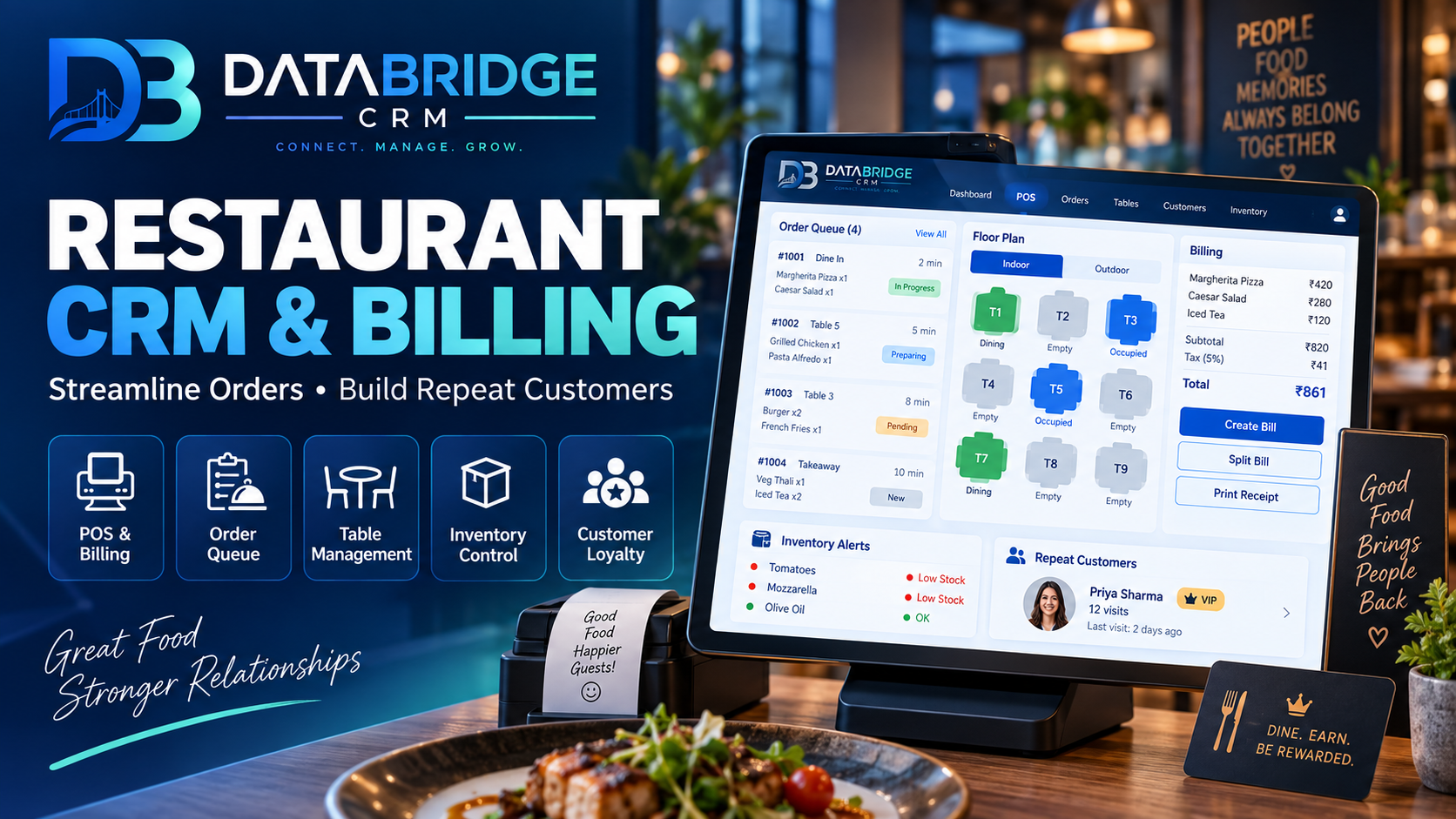
- Fast, accurate billing (POS) — orders billed in a few clicks with automatic tax and discount calculation
- Kitchen order ticket (KOT) automation — orders sent directly from the counter or table to the kitchen printer, cutting communication errors
- Inventory & recipe tracking — know exactly how much stock is used per dish, reducing wastage and stockouts
- Table & order management — track which tables are occupied, orders in progress, and turnaround time
- Customer database & loyalty — every diner's order history stored, so repeat offers and loyalty rewards can be sent automatically
- Multi-channel order handling — dine-in, takeaway, and delivery orders managed from one screen instead of separate systems
Turning Diners Into Repeat Customers
The real growth lever for most restaurants isn't new customer acquisition — it's getting existing customers to come back more often. A restaurant CRM captures every diner's contact details and order history automatically at billing, which can then be used to send WhatsApp offers, birthday discounts, or "we miss you" messages to lapsed customers — all without manual list-building.
Why an Integrated System Beats Separate Tools
Many restaurants run a separate billing machine, a WhatsApp broadcast tool, and a paper-based loyalty card — none of which share data. When billing, inventory, and customer marketing are combined into a single platform like DataBridgeCRM's Restaurant CRM module, a customer's order at checkout automatically updates inventory and adds them to your marketing list, with zero manual data entry.
What to Look For Before Choosing
Prioritize software that handles billing speed during rush hours, integrates inventory to prevent last-minute stockouts, and includes built-in customer marketing rather than requiring a separate tool. Cloud-based systems are also worth prioritizing so you can check sales and inventory remotely, even when you're not on-site.
The Bottom Line
A restaurant that runs on disconnected paper and manual tools will always struggle to scale past a certain size. A unified restaurant CRM and billing system turns every transaction into both a smooth customer experience and a data point that helps bring that customer back again.
See how it works for your restaurant. Explore the Restaurant CRM module or book a free demo.

