
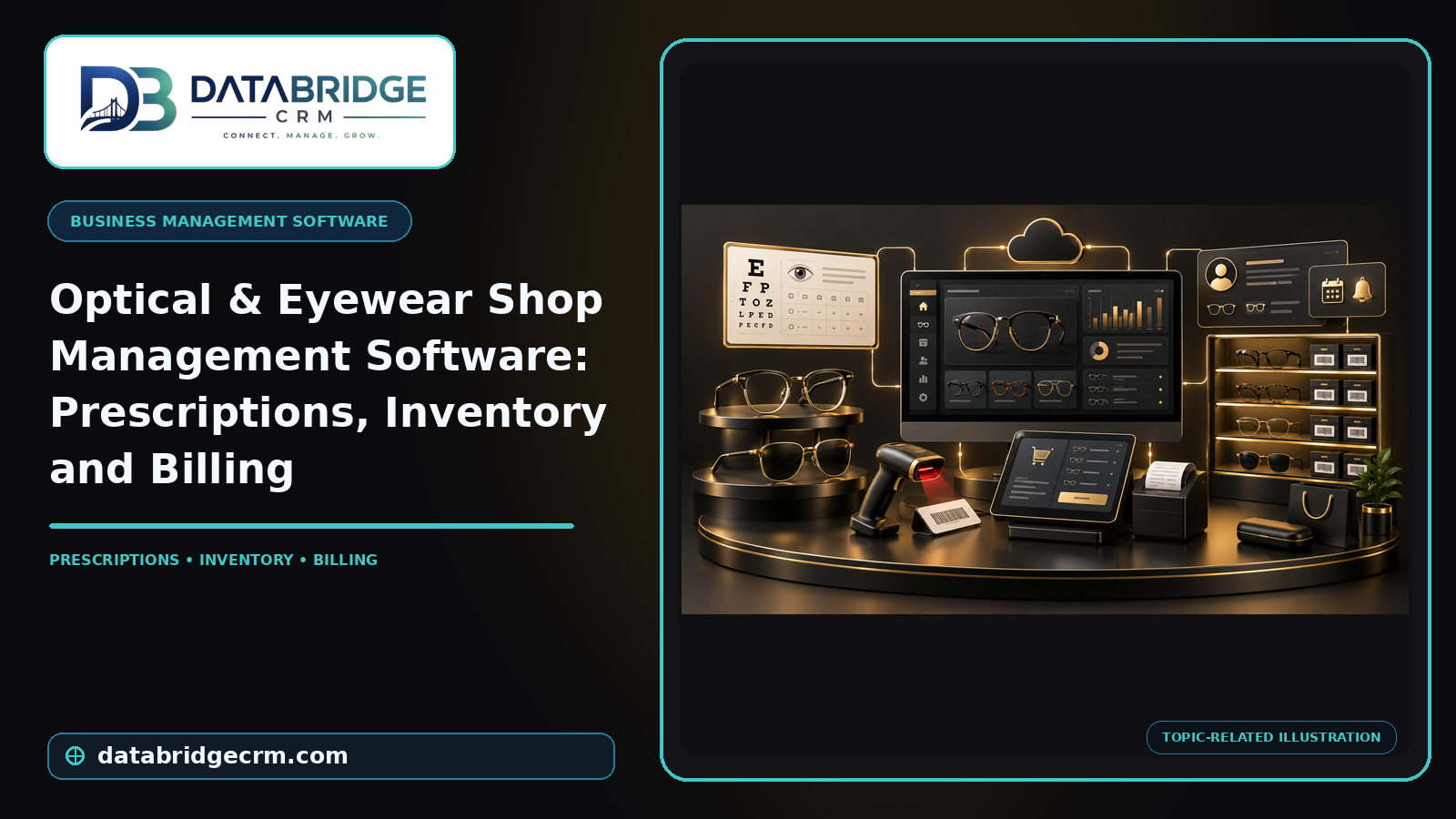
Optical shops manage a retail inventory unlike most other categories — frames come in countless combinations of brand, style, and size, lenses are customized to individual prescriptions, and customers expect their prescription history to be remembered accurately for future visits. Optical shop management software exists to handle this specific complexity properly.
Why Generic Retail Software Falls Short for Optical Shops
Standard retail billing tools aren't built to handle prescription-linked orders, where lens specifications need to be matched precisely to a customer's eye test results, or to track frame inventory with the level of variant detail (brand, model, size, color) that optical retail requires — forcing many optical shops to manage prescriptions and inventory through separate, disconnected processes.
Core Features of Optical Shop Management Software
- Prescription & customer record management — storing each customer's eye test results and prescription history, making repeat orders and future eye test comparisons straightforward
- Frame & lens inventory tracking — managing detailed inventory across frame brands, models, sizes, and lens types, rather than treating stock as generic, uniform items
- Order tracking through to delivery — following each custom order from prescription capture through lens fitting to final delivery, particularly important since orders often aren't completed same-day
- Accurate, itemized billing — combining frame cost, lens type, and any add-on treatments (anti-glare, blue light filter) into a clear, accurate invoice
- Eye test & checkup reminders — automated reminders for customers due for their periodic eye checkup, encouraging repeat visits
- Multi-branch support — for optical retail chains, centralized inventory and customer record visibility across every branch
Why Prescription History Matters for Customer Retention
A customer whose optical shop already has their prescription on file, and can quickly compare it to a new eye test, experiences a smoother, faster service than starting from scratch each visit — this convenience is a meaningful factor in why customers stay loyal to a specific optical shop rather than switching.
Why Detailed Inventory Tracking Reduces Lost Sales
An optical shop that can't quickly confirm whether a specific frame style and size is in stock risks losing a sale to a customer unwilling to wait or search elsewhere. Detailed, accurate inventory tracking — down to the specific variant — prevents this kind of easily avoidable lost sale.
Turning Eye Checkup Reminders Into Repeat Business
Eye health guidance generally recommends periodic checkups, giving optical shops a natural, value-adding reason to reach out to past customers. Automated reminders based on a customer's last visit date turn this recommended checkup cadence into a reliable driver of repeat business, rather than relying on customers to remember on their own.
Why an Integrated System Helps Optical Retailers
DataBridgeCRM's retail billing and inventory tools, adapted to the specific needs of prescription and variant-heavy inventory, help optical shops manage prescriptions, stock, and billing in one connected system rather than juggling separate processes for each.
See how it works for your optical shop. Talk to a DataBridge consultant or book a free demo.

