
So you want to launch a hotel booking platform. Good idea. People do search for stays online, and plenty of hotel owners would love to show up in those searches.
But here's the part that surprises first-timers: the website is the easy bit. The hard bit is everything behind it. Who's allowed to list a hotel? How do you describe rooms so they can actually be compared? What happens when a traveller sends a request? Who gets paid, how much, and when?
Hotel Marketplace CRM Software exists to answer those questions in one place. Hotel vendors and travellers share a single platform, and you stay in charge of listings, bookings and commissions without chasing anyone over email.
What Is Hotel Marketplace CRM Software?
It's software for building and running an online accommodation marketplace. Hotels, resorts, guest houses and similar providers put their properties on your platform. Each vendor looks after what they're permitted to edit, travellers browse and send booking requests, and you oversee all of it.
The modules vary by product, but expect things like hotel onboarding, listings, room attributes, locations, extra services, booking requests, payments, commissions, vendor withdrawals, reports and support tickets.
And no, this isn't the same as ordinary hotel software. That kind runs one property. A multi-vendor marketplace is built for many providers sharing one platform, which is a very different job.
Why Build a Marketplace and Not Just Another Hotel Website?
Travellers like options. Showing them several hotels in one place beats making them open ten tabs. Small hotels and guest houses like it too, since many can't afford to build and maintain a booking platform alone. Being on yours gives them reach they wouldn't have otherwise.
You also get a business model. Charging vendors a commission on eligible bookings is common, but it only works when the rules and payment records are clear. Managing many vendors means reviewing property details, approving sign-ups and watching bookings, and a central admin panel keeps that from becoming a mess. Add location-based browsing, since lots of people search by city or destination, and your directory becomes easier for guests to use and for you to manage.
What a Good Platform Should Cover
Start with vendor onboarding. Hotel owners register and submit their details, and you decide who gets approved. Then comes the content: listings, rooms and amenities. Hotel names, descriptions, photos, locations and facilities should be organised so a traveller knows what they're looking at. Room types need structure (capacity, amenities, pricing), though the exact fields depend on setup. Wi-Fi, pool, parking and food should follow one standard format, so "included" means the same on every listing.
Locations come next. Sorting properties by city, region and country gives you a cleaner directory and helps people find hotels by destination.
Then the part that matters most day to day: booking requests. Vendors review what travellers send and, depending on the workflow, approve or cancel. You should be able to see relevant booking activity from your side too.
Money needs its own thought. The platform can work out its commission on eligible transactions using your rules, and withdrawal tools help you review vendor payment requests and settlements. Settle the percentage, the payment timeline and who handles refunds before the first vendor joins. It's far harder to change later.
Finally, the supporting cast: registered user management, reports (which may show active hotels, bookings, commissions and revenue trends), ad management for promotions, and support tickets for the questions that always come up.
How It Works in Practice
- You launch the marketplace and configure the settings.
- Hotel owners apply to join.
- Approved vendors add hotel details, rooms, amenities and location.
- Travellers browse and read up on places to stay.
- One of them sends a booking request.
- The vendor reviews it and approves or cancels.
- Payment, commission and withdrawal records are kept as configured.
- You look at reports and activity to see how things are going.
Who Is It For?
Anyone who wants to run a marketplace, not just a hotel. Travel startups, hotel aggregators and tourism companies are the obvious ones. So are entrepreneurs who'd rather focus on one city, state or travel region, and hospitality tech companies that want a base for connecting providers with travellers.
What You Get Out of It
Less juggling. Vendor information lives in one admin platform, listings stay tidy, bookings are visible, commissions and withdrawals are on record, and locations keep the directory sensible. Users, ads, reports and support are covered by the available modules. Grow later, and you add more providers without starting over.
Hotel Marketplace CRM vs Single Hotel Management Software
Both serve hospitality, but they answer different questions.
| Area | Single Hotel Management Software | Hotel Marketplace CRM |
|---|---|---|
| Main Purpose | Manage one hotel or property | Manage multiple hotel vendors on one platform |
| Property Management | Maintains the hotel's own rooms and services | Organises listings from participating hotels |
| Vendor Management | Usually not a core requirement | Supports hotel vendor registration and administration |
| Booking Requests | Handles reservations for the property | Coordinates requests between travellers and hotel vendors |
| Commission Management | Usually not required | Can manage marketplace commission rules |
| Platform Administration | Focused on one property's operations | Manages vendors, users, listings and marketplace activity |
Hotel Management Software by DataBridge CRM
Not everyone reading this wants to build a marketplace. Plenty of you just want to run your own hotel without the register, the phone calls and the sticky notes. That's what DatabridgeCRM Hotel Management Software is for.
It's made for hotels, resorts, guest houses, lodges and other places that host guests. Room bookings, room availability, housekeeping, room services, food delivery, billing, guest records, staff and leave all sit on one dashboard. So when a guest asks about their booking, or housekeeping wants to know which rooms are free, nobody has to go hunting through files.
The screens are meant to be simple. Owners and staff should be able to check booking details, manage room services and see what's going on around the property without calling someone technical. A fast system also helps where it counts: billing, guest service and day-to-day operations as they happen.
DataBridge describes the software as affordable, secure and reliable, so it can suit a small hotel as easily as a big hospitality business. The security part deserves a second look, because guests trust you with a lot. Their records, booking information and billing details are exactly what its security and data protection policies are meant to protect, along with your own hotel data.
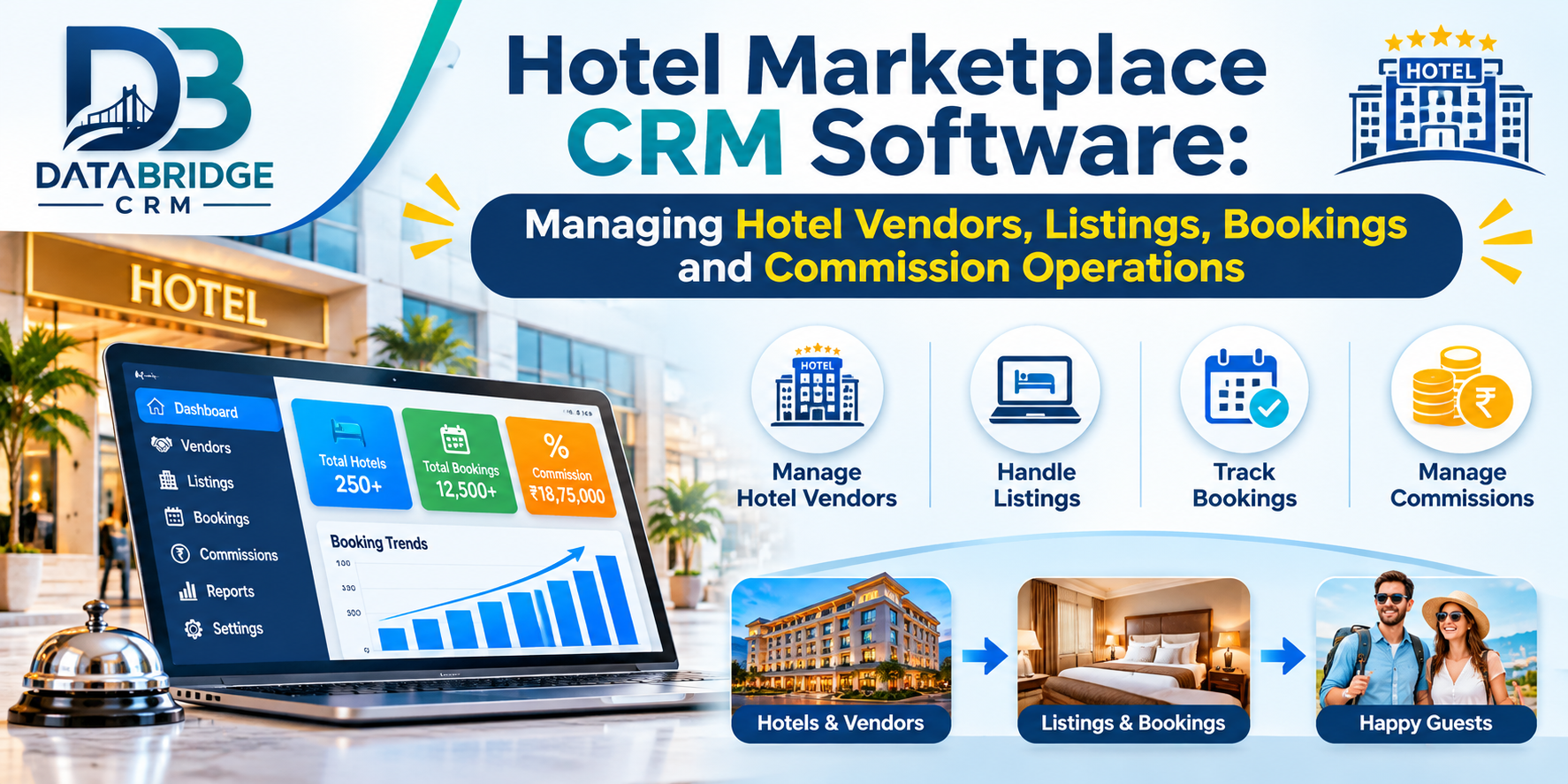
And if what you really want is a platform where many hotels list themselves, DataBridge has a marketplace solution too. Its published modules include Dashboard, Hotel Listings, Hotel Attributes, Manage Locations, Extra Services, Vendor Requests, Registered Users, Payments, Withdrawals, Manage Ads, Reports and Requests, Analytics and Support Tickets. It also describes hotel onboarding, vendor hotel configuration, room attributes, location-based listings and commission management, with a dashboard showing active hotels, daily bookings, platform commissions and revenue trends.
Whichever fits you, look through the modules and ask for a demo. You can read more on the official DataBridge CRM Hotel Management Software page.
DatabridgeCRM is developed and powered by JayShree Technosoft.
How to Choose the Right Hotel Marketplace Software
Don't judge it by a feature list. Test it against the marketplace you actually plan to run. A few things to check:
- How vendor registration and approval work
- How listings and room attributes are managed
- How locations and destinations are organised
- How a traveller sends a booking request (try it yourself)
- How vendors approve or cancel one
- How commissions are calculated and withdrawals handled
- Who deals with payments and settlements
- What user roles and admin permissions exist
- Which reports, analytics and support tools are included
- What customisation, implementation and support look like
Mistakes to Avoid When Launching
Letting vendors in unchecked is the big one. Decide how you'll review hotels before any listing goes live. Thin listings come next: missing room details, vague amenities and unclear locations make travellers leave. Then there are fuzzy commission rules, so agree on percentages, payment responsibilities and withdrawal conditions up front.
Test the booking flow, too. Submit, approve and cancel requests with sample vendor accounts, and fix whatever feels clumsy. And plan support from day one. Vendors and travellers will have questions about listings, requests and payments, and they'll expect an answer.
Conclusion
A hotel marketplace depends on three groups working together: hotel owners, travellers and your admin team. Try to coordinate them with separate tools and vendor onboarding, listings, requests and commissions get harder than they should be.
Hotel Marketplace CRM Software gives you one place for all of it. With organised vendor management, listings, booking requests, payments and reports, the platform stays easier to control as it grows.
DataBridge CRM covers both sides of hospitality: hotel management software for running a property, and a multi-vendor platform for building a hotel booking marketplace. Go through the modules and request a demo before settling on a configuration.
Frequently Asked Questions
1. What is Hotel Marketplace CRM Software?
It's a digital platform for managing multiple hotel vendors, property listings, room information, booking requests, payments and marketplace administration.
2. What is multi-vendor hotel booking software?
It lets several hotel owners or accommodation providers list their properties on one platform and manage their own property and booking information.
3. Can hotel vendors manage their own room listings?
Usually, yes. A multi-vendor platform can give vendors a panel for hotel details, room types and pricing. What they can do depends on how it's configured.
4. How does a hotel marketplace earn commission?
By charging a predefined commission on eligible bookings made through the platform. The rules and settlement arrangements depend on the marketplace configuration.
5. Can I create my own hotel booking platform?
Yes. A suitable marketplace solution lets hotel vendors list properties and travellers search for stays and send booking requests, all on a platform you control.
Discover hospitality and business management solutions at DataBridge CRM .
Hotel Marketplace CRM, Hotel Booking Marketplace Software, Multi Vendor Hotel Booking Software, Hotel Vendor Management, Hotel Listing Management, Hospitality Marketplace Software, Hotel Booking Platform, Hotel Commission Management, Hotel Management CRM, DataBridge CRM
#HotelMarketplaceCRM #HotelBookingSoftware #MultiVendorMarketplace #HotelManagementSoftware #HospitalityTechnology #HotelVendorManagement #BookingPlatform #TravelTechnology #HospitalityBusiness #DataBridgeCRM

